Where Online Casino Player Data Actually Lives: And Who Controls It
 Jacob Mitchell
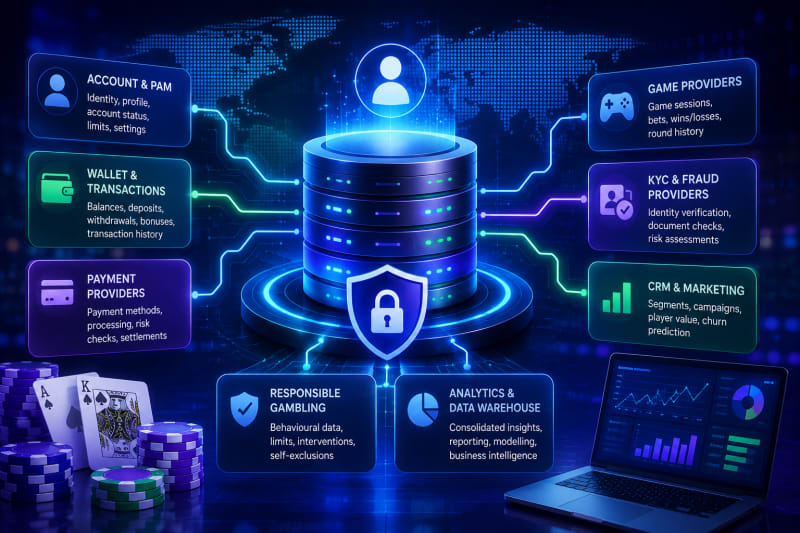
Online casino player data rarely lives in one place. A single player relationship can generate information across the casino platform, Player Account Management (PAM) system, wallet, payment providers, game suppliers, KYC services, CRM software, responsible gambling tools, fraud systems and analytics infrastructure. Some of those systems are controlled directly by the operator, while others belong to third-party technology providers.
This makes player data architecture more complicated than the familiar idea of an operator having a "customer database." The casino may be responsible for the player relationship and determine how personal information is used, yet still depend on several external companies to store, process or return important parts of that information. The practical issue is therefore not simply who owns the data. It is how much of the player relationship the operator can independently access, connect and retain.
"The modern online casino does not really have one player database. It has a player data network, and control depends on how much of that network the operator can actually see, connect and move."


The PAM Sits at the Center, but It Does Not Hold Everything
The PAM is usually the closest thing an online casino has to a central player record. It connects the customer to an account and typically manages core information such as registration details, account status, balances, bonuses, limits and transaction references. In many casino stacks, it also acts as the common identifier connecting the player to other systems.
However, the PAM should not be treated as a complete record of the customer. The UK Gambling Commission's framework for remote gambling equipment, for example, distinguishes between customer details, accounts and wallets, gambling transaction records, management information, external interfaces, backups and disaster-recovery copies. This reflects the practical architecture of online casinos, where different categories of player information can sit in different systems.
The distinction becomes particularly important when the PAM is provided by a third-party platform. The operator may control the commercial relationship with the player while the platform provider operates the infrastructure containing a substantial portion of the account history. Under European data protection principles, this can also create a controller-processor relationship: the operator determines why and how personal data is processed, while technology companies can process that information on its behalf.
Technical possession and practical control are therefore different things. An operator can be legally responsible for information that physically resides in infrastructure operated by someone else.
One Player Exists Across Several Data Environments
Once the player begins using the casino, the data footprint expands quickly. A deposit creates a wallet event and a payment transaction. Launching a game creates a session with a game provider. A bonus creates another set of records. Identity verification can send information through a KYC provider, while marketing activity produces CRM and campaign data.
A simplified player data journey can therefore involve:
- PAM and wallet: identity, account status, balances, bonuses, limits and core transactions.
- Payment infrastructure: deposits, withdrawals, payment methods, authentication and transaction status.
- Game providers or aggregators: game sessions, stakes, wins, losses, rounds and technical game events.
- KYC and fraud providers: verification results, risk signals and supporting compliance information.
- CRM and marketing tools: segments, campaign interactions, churn indicators and player-value classifications.
- Responsible gambling systems: behavioural indicators, limits, interventions and case histories.
- Data warehouses: consolidated historical information used for reporting, modelling and analysis.
These are not simply duplicate copies of the same customer profile. Each system sees the player through a different operational lens. The wallet understands money movement, the game supplier understands gaming activity, the CRM interprets commercial behaviour, and the KYC system evaluates identity or risk.
The operator's challenge is to connect those views into something that represents the complete relationship.
Game Providers Can Hold Some of the Richest Behavioural Data
Game suppliers are a good example of how control becomes distributed. When a customer launches a slot or live casino game, the provider needs enough information to create the session, process bets, determine outcomes and reconcile transactions with the operator. Depending on the integration, the supplier may work primarily with a pseudonymous player identifier rather than the customer's full identity.
Even with limited identifying information, the provider can generate highly granular behavioural data. Individual records can contain game and round identifiers, stakes, wins and losses, timestamps, bonus activity, game states and technical events. Across many sessions, this can produce a detailed record of how an individual account interacts with a particular supplier's portfolio.
The casino therefore tends to know considerably more about who the player is, while game providers can hold highly detailed records of what happened during play. Neither side necessarily holds the entire picture.
The richest version of a player profile often does not exist as a finished record anywhere. It has to be assembled from systems that were originally built to perform completely different jobs."
For operators, this makes the way data is returned almost as important as the existence of the data itself. Detailed game information delivered in near real time can support behavioural monitoring, fraud detection and segmentation. The same information delivered much later may still be valuable for financial reconciliation and reporting, but considerably less useful for decisions that need to happen during or shortly after play.
Payments and KYC Create Their Own Data Layers
Payments add another division of responsibility. The casino can record that a player made a €200 deposit, but the payment provider may process additional information relating to the payment instrument, authentication, transaction route, risk checks and settlement. The casino sees the transaction as part of the player's gambling lifecycle, while the payment provider sees it as part of a financial lifecycle.
This separation matters during chargebacks, fraud investigations, AML reviews and withdrawal checks. Having a deposit recorded in the PAM does not necessarily mean the operator holds every piece of information generated while that deposit was processed.
KYC infrastructure works in a similar way. Operators increasingly rely on specialist providers for identity and age verification, document checks, sanctions screening, geolocation and fraud detection. The casino may retain the result of a check while more detailed verification information is processed or stored in the provider's environment.
This creates an important distinction between the decision and the evidence behind the decision. A KYC PASSED status may be enough to operate an account, but historical compliance reviews can require considerably more context. Operators therefore need access to sufficient evidence even when the underlying verification process has been outsourced.
Responsible Gambling Shows Why Fragmented Data Must Be Reconnected
Responsible gambling is where the limitations of fragmented data become particularly visible. Meaningful behavioural monitoring depends on information that originates across multiple parts of the technology stack. Spend patterns can come from the wallet, playing time from gaming sessions, deposit behaviour from payment systems, limit changes from the account platform and customer concerns from support interactions.
The UK Gambling Commission requires relevant remote operators to monitor indicators including customer spend, patterns of spend, time spent gambling, gambling behaviour, customer-led contact, use of gambling management tools and account indicators. Its guidance also emphasises the importance of integrating systems to build a more complete picture of customer activity and previous interactions.
For operators, this turns data latency into a compliance consideration. A supplier can provide accurate gaming information and still provide it too slowly for certain forms of behavioural monitoring. A daily data feed and a near-real-time event stream may contain similar information, but they provide very different operational capabilities.
This is also why outsourcing technology does not remove the operator's responsibility. The licensed operator remains responsible for the effectiveness of its controls even where parts of the underlying infrastructure are provided by B2B suppliers. The architecture therefore needs to do more than preserve records. It needs to make relevant information available when operational decisions are being made.
CRM Creates a New Type of Player Data
CRM and analytics platforms add another layer because they do not simply store what the player has done. They interpret it. Raw account and transaction events can be converted into classifications such as VIP prospect, high-value customer, churn risk, reactivation candidate or bonus-sensitive player.
This is derived data rather than basic transactional data. A €100 deposit is an event. A model predicting that the same customer has a high probability of churning is an interpretation based on multiple events.
That difference becomes strategically important as operators use more automated segmentation and predictive models. If an external CRM or optimisation platform produces the operator's most useful customer classifications, part of the organisation's knowledge about its own players can effectively sit inside the supplier's ecosystem.
"An operator has stronger data control when it can reproduce its understanding of a player without depending on a vendor dashboard to explain what that player is worth or likely to do next."
This does not mean operators need to build every analytical tool internally. It means they need to understand which insights can be exported, which are proprietary to a supplier and which can be reconstructed from the underlying data.
The Data Warehouse Becomes the Casino's Long-Term Memory
This fragmentation explains why central data warehouses and similar analytical environments have become so important. Rather than replacing operational systems, they bring information from those systems together. Registration, deposits, gaming, bonuses, withdrawals, CRM events and responsible gambling activity can be mapped to the same customer and analysed over time.
Operational systems and analytical systems serve different purposes. A PAM needs to know whether a transaction should succeed now. A data warehouse needs to understand what thousands or millions of historical transactions reveal about customers, products and the business.
For operators, centralising this information also reduces technology dependence. If granular event-level data is continuously exported into infrastructure the operator controls, changing a PAM, CRM or aggregator remains a difficult migration but does not necessarily erase years of institutional knowledge. If historical information is mainly accessible through supplier dashboards, the dependence is much greater.
This is an important but sometimes overlooked form of vendor lock-in. A casino can replace software while still discovering that it cannot easily replace the history stored inside that software.
Data Exists Beyond the Live Casino Platform
The production environment is only one part of the data footprint. Player information can also be replicated into analytics systems, archives, logs, disaster-recovery environments and backups. Third-party suppliers can maintain their own copies according to contractual, operational and regulatory requirements.
As a result, deleting a player record from the main account database does not necessarily mean every associated copy immediately disappears. Different systems can operate under different retention schedules, and some information may need to be retained for legal, financial or regulatory reasons.
This makes data mapping increasingly important for operators with complex technology stacks. Effective governance requires knowing not only which supplier receives information, but also what category of information it receives, why it processes it, where relevant copies exist and how long they are retained.
Real Control Becomes Most Visible During a Platform Migration
The difference between theoretical and practical control is often exposed when an operator changes suppliers. While the casino may clearly own the customer relationship, migrating that relationship depends on whether the underlying information can actually be extracted and reconstructed.
Player identities and balances are only the beginning. Historical transactions, gaming activity, consent records, limits, exclusions, KYC information, responsible gambling interactions and relevant CRM history may also need to remain connected after the migration. Proprietary formats, incomplete exports or data available only through dashboards can make this substantially harder.
Data portability is therefore more than an exit clause in a supplier agreement. API availability, export formats, data granularity, retention periods and migration support directly influence how dependent an operator becomes on its technology stack.
A casino that can reconstruct its player history independently has significantly more freedom to change suppliers than one whose most complete customer view exists inside third-party systems.
Player Data Architecture Is Becoming a Strategic Asset
Online casino technology has traditionally been evaluated through factors such as game coverage, payment options, uptime, conversion and speed to market. Data architecture increasingly belongs in the same discussion because it affects almost every major operational function.
Connected player data supports compliance and responsible gambling, but it also improves fraud detection, payment analysis, CRM segmentation, retention modelling, customer support and management reporting. The objective is not necessarily to bring every database in-house. Modern online casinos depend on specialist technology providers, and distributing processing across several systems is often both necessary and efficient.
The stronger model is architectural control. The operator understands where important information originates, which systems process it, how quickly it becomes available, how different records connect and whether the relevant history can be retained and moved independently of individual suppliers.
In that sense, control of player data is becoming less about who owns the physical server. It is about who can reliably access, connect, interpret and preserve the history of the player relationship. For online casino operators increasingly dependent on interconnected B2B technology, that distinction is becoming a fundamental part of both operational resilience and long-term platform strategy.