The Netherlands Built a Legal Gambling Market and The Black Market Just Took Half
 Jacob Mitchell
Revenue-based channelization fell below 50% for the first time since the Dutch market opened, and the regulator's own numbers show why.
The Netherlands built one of Europe's most closely watched legal gambling markets, and for three years, it worked. The Netherlands opened its licensed online casino and betting market on 1 October 2021, and licensed operators handled the clear majority of every euro wagered online through 2024. Its own regulator now says that majority is gone. The Kansspelautoriteit (KSA), the Netherlands Gaming Authority, confirmed in its 2025 annual report that revenue-based channelization fell to 49% in the first half of 2025, down from 51% at the end of 2024, the first time licensed operators have taken less than half the market by money since it opened.
Illegal operators generated an estimated €617 million in gross gaming revenue (GGR) in the first half of 2025, compared with €600 million for licensed operators, according to the KSA's own count. Full-year 2025 illegal online GGR reached roughly €1.2 billion, the KSA estimates, while the licensed sector's online revenue fell 18.5% to about €1.202 billion for the year. Dutch trade body VNLOK, which represents licensed operators, counted the same trend and did not soften the language. "The Dutch regulated market is at a dangerous crossroads," it said.
Two ways to count the same collapse
Channelization measures how much Dutch online gambling happens through licensed operators instead of unlicensed ones. Channelization looks completely different depending on which number gets read. Its player-based reading stayed reassuring, with roughly 94% of Dutch online gamblers using only licensed sites through 2025, per the KSA's own survey data, a share barely changed from prior years.
By money, the story flips entirely. Revenue-based channelization slid from 58% in the first half of 2024 to 51% at the end of that year, then to 49% in the first half of 2025, before the KSA revised the second-half 2025 figure up to 53% after correcting its methodology. Even at 53%, nearly half of everything wagered online in the Netherlands now flows to operators the country never licensed. Monthly licensed accounts still reached 1.38 million in the second half of 2025, so the players never left. Their money increasingly did.
Three pressures pushing players offshore
Three regulatory changes coincide with the decline, and the KSA itself is reluctant to rank them.
- Deposit limits. Since October 2024, players 24 and older face a net monthly cap of €700, and those 18 to 24 face €300. Average monthly losses per account fell from €146 in the second half of 2024 to €119 in the first half of 2025.
- Tax increases. The gambling tax rose from 30.5% to 34.2% on 1 January 2025, then to 37.8% on 1 January 2026, pushing the effective burden toward 40% once the additional gambling levy is added.
- Advertising bans. Restrictions arrived in stages, with role-model ads banned in April 2022, untargeted advertising banned in July 2023, event and program sponsorship banned in July 2024, and sports sponsorship banned in July 2025. Each measure protects players on paper. Each measure also removes a reason to stay with a licensed operator instead of an unlicensed one advertising the same odds without any of the friction.
The tax that didn't pay for itself
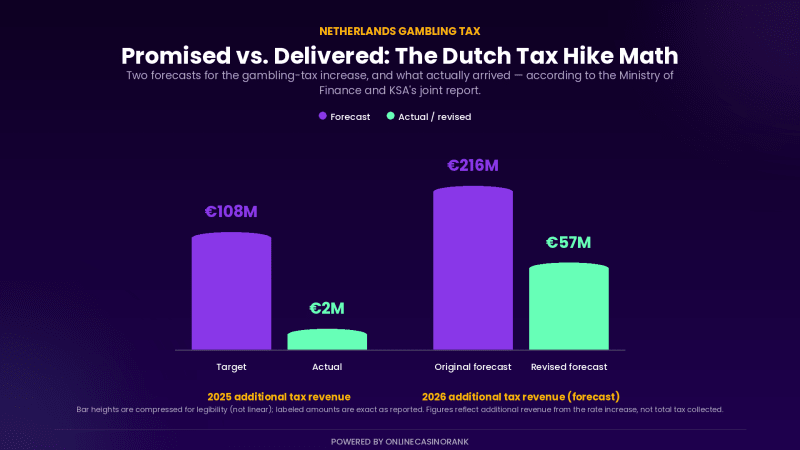
The tax increase was supposed to raise real money for the state. The tax increase generated just €2 million in additional revenue in 2025, according to a joint report from the Ministry of Finance and the KSA, against a target of €108 million. Its shortfall triggered no reversal, only a promise to keep raising the rate anyway.
Total gambling tax receipts reached €1.036 billion in 2025, barely above the €1.034 billion collected in 2024, despite the higher rate. Officials could not fully isolate how much of the shrinkage came from the tax itself rather than the deposit limits and advertising bans arriving at the same time, the joint report said. The government's own 2026 forecast has already slipped, too. Officials once expected the 2026 rate rise to add €216 million on top of 2024 revenue. They now expect €57 million.
The pain reaches land-based venues as well. Visits to gaming halls and Holland Casino properties fell from 4.6 million in the first quarter of 2025 to 4.1 million a year later, an 11% drop, and operators JVH Gaming and Fair Play Casino both closed venues citing the tax directly. Holland Casino Online, the state-owned operator, absorbed €13.5 million (US$15.66 million) in extra costs in the first half of 2025 alone from the rate rise, even as the KSA extended its license for five more years, through 2031.
A shrinking tax base multiplied by a bigger percentage is still a smaller number, and the Netherlands proved that twice in a row now. Treating the 2027 evaluation as the next decision point wastes a year the market doesn't have. Freeze the rate where it sits, isolate channelization as the one metric that decides whether the freeze worked, and revisit the tax only after that number moves in the right direction.


Enforcement chasing a market it can't fully see
The KSA fined five licensed operators a combined €8.6 million in 2025, mostly for failing duty-of-care checks on heavy losers. The KSA fined four illegal operators a combined €31.2 million over the same period, including a record €24.8 million penalty against Novatech, the company behind the Qbet and 55Bet brands, in early 2026. Its own law limits how hard it can hit them.
Dutch fines cannot exceed 10% of an operator's global GGR, and KSA chairman Michel Groothuizen has said the Novatech penalty would have topped €100 million without that ceiling. The regulator is asking the Justice Ministry to change it.
Roughly 50,000 illegal gambling advertisements appeared across Dutch social media every month in 2025, the KSA's annual report found, and the regulator filed more than 4,600 takedown reports to Meta in April 2026 alone. Amsterdam gaming lawyer Justin Franssen puts the black market's share of those ads even higher, estimating around 95% of gambling advertising on Dutch social media now comes from unlicensed operators.
Groothuizen's response is Project Disconnect, an alliance built to choke off the infrastructure unlicensed sites depend on instead of chasing individual domains one at a time. Paid Google search ads for illegal Dutch gambling sites have nearly disappeared since August 2025, and registry SIDN has pulled illegal .nl domains as fast as regulators can identify them. New ones replace them just as quickly.
It's like battling a Hydra , Cut off one head, and two more appear.


A lawsuit aimed at the biggest illegal name
Nederlandse Loterij, the Dutch state lottery operator, sued Qbet's operators directly rather than wait for the KSA to catch up. Nederlandse Loterij filed the case at The Hague, with a first hearing held on 9 April 2026. Its target, Novatech, already carries the KSA's largest-ever fine and also operates the 55Bet brand alongside Qbet.
Not only the direct offender, but also everyone behind it who facilitates this site.

The case does not stop at Novatech itself. Nederlandse Loterij is also naming the trust offices and letterbox companies used to run Qbet, along with individual directors, an approach designed to stop an operator from simply dissolving one shell and reopening under another. This is Nederlandse Loterij's second such action. It sued Costa Rica-based Lalabet in March 2025, claiming that single operator cost the lottery between €15 million and €20 million in lost turnover across 2023 and 2024 alone. Nederlandse Loterij puts the current scale of the problem at roughly 200,000 Dutch residents now gambling on unlicensed platforms.
Everyone keeps measuring this fight in fines and percentages, but the more useful number is the one nobody's tracking: how many of those 200,000 players think they're still on a legal site. Regulators flagged that illegal operators buy up expired Dutch domains, old restaurants, schools, local coaches, to inherit search trust they never earned. If an unfamiliar Dutch gambling site ranks above a known licensed brand for a plain search term, treat the ranking itself as the warning sign, not as proof of legitimacy.
Where this goes next
H2 Gambling Capital, the independent analytics firm tracking European gambling markets, projects revenue-based channelization will fall further to 47% in 2026 before it stabilizes. H2 Gambling Capital based that call on 2025 estimates putting onshore gross win at roughly €1.05 billion against a near-identical offshore figure, a dead heat the firm expects to tip further offshore once the next tax rise lands. Its forecast assumes no further policy shock, and the Dutch government is already planning one.
The coalition government of D66, CDA, and VVD has proposed a complete ban on online gambling advertising and bonuses, expected as a bill in the first quarter of 2027. It has also floated a single deposit limit applying across every licensed operator at once rather than per account, plus a higher minimum age of 21 for higher-risk games. The only follow-up currently locked into the calendar is a policy evaluation in 2027, a timeline VNLOK has already called too slow to matter.
Holland Casino Online general manager Nicolas Fleiderman put the current range at 45% to 50% of GGR in mid-2026. Unlicensed operators, he noted, skip the affordability checks and duty-of-care obligations licensed platforms must carry, which is exactly the gap that keeps pulling players across.
What the neighbors already learned
Denmark and Sweden offer a preview of where this can go. Denmark's channelization has fallen to 72%, matching Sweden's rate, down from around 90% in both markets in 2022, according to H2 Gambling Capital data cited by iGaming Business. Advertising restrictions plus high tax pushed both markets in the same direction the Netherlands is now moving, and neither has recovered the ground it lost.

No Dutch policy reversal is scheduled before 2027. The KSA's own methodology has already been revised twice this year, moving the headline number from 49% up to 53% without changing the underlying trend. VNLOK wants faster action. The government wants more data. Illegal operators, in the meantime, do not appear to be waiting for either.