Nobody Can Agree How Big Germany's Online Gambling Black Market Actually Is
 Jacob Mitchell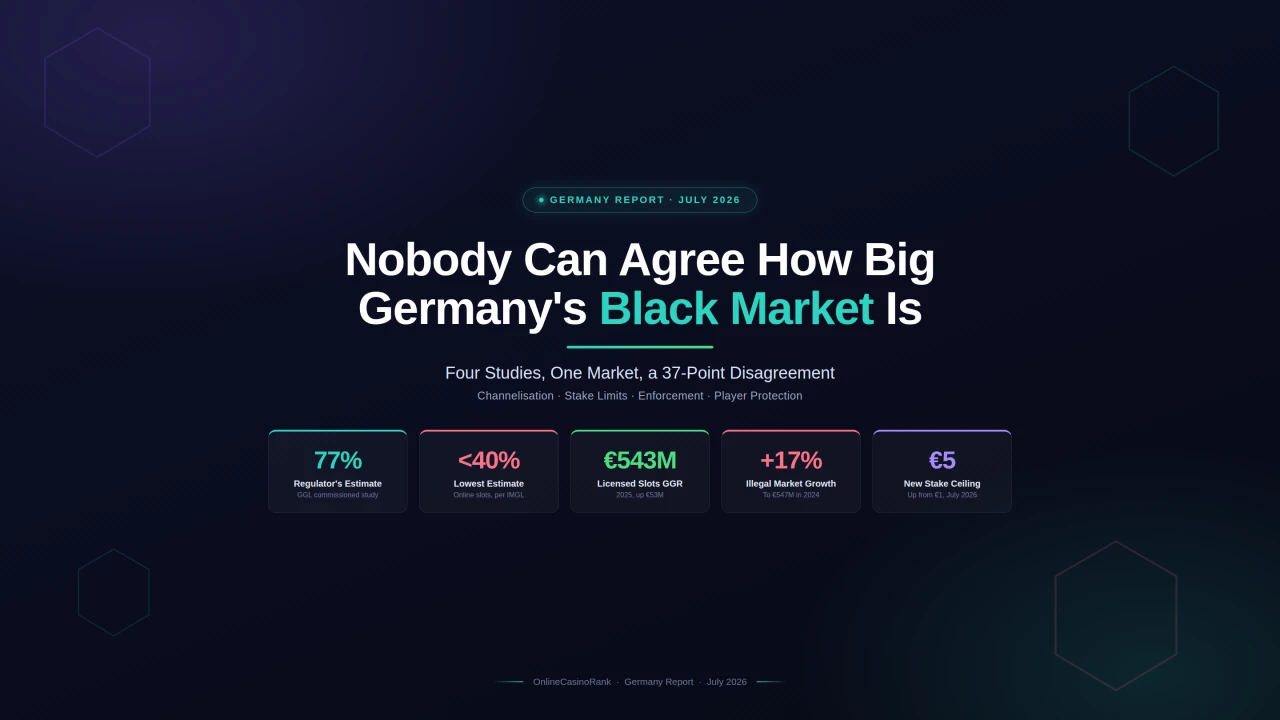
Channelisation is the share of a country's gambling activity that reaches licensed operators rather than illegal ones. Germany measures channelisation through competing studies that disagree by nearly 40 percentage points. The Gemeinsame Glücksspielbehörde der Länder (GGL), Germany's joint gambling authority, puts the figure at 77.03%. The Deutscher Online Casinoverband (DOCV), the country's online casino trade body, puts it near 50%. Players in Germany access licensed slots at operators including bwin, Tipico, and LeoVegas, all of which operate under the same restrictions the dispute concerns.
We compared every published estimate of Germany's illegal online gambling market against the GGL's own licensed market data. Both sides of the market grew. The illegal side grew faster, and five years into Europe's most heavily monitored online casino framework, the basic question of how much demand it captures remains unresolved.
Key Takeaways:
- Licensed virtual slots generated €543 million in gross gaming revenue (GGR) during 2025, an increase of €53 million year-on-year, according to the GGL's 2025 activity report.
- Illegal online gambling GGR reached €547 million in 2024, up 17% from approximately €466 million in 2023, according to a GGL-commissioned study by the Blockchain Research Lab.
- Published channelisation estimates span 37 percentage points, from below 40% for online slots specifically to 77.03% for online gambling overall.
- Germany replaced its flat €1 slot stake limit on 1 July 2026 with a tiered system reaching €5, the first stake adjustment since the market opened in 2021.
- The GGL declined to publish its own standalone black market estimate in its 2025 report, a methodological shift from prior years.
- Germany's five-year Interstate Treaty review is due by the end of 2026 and will examine channelisation, deposit limits, and advertising rules.
We built this analysis from the GGL's 2025 activity report, the GGL-commissioned black market study conducted by the Blockchain Research Lab and published in March 2026, channelisation research by University of Leipzig economist Gunther Schnabl commissioned by the DOCV, a late-2025 study by the Handelsblatt Research Institute, and a June 2026 assessment published by the International Masters of Gaming Law (IMGL). Tax and structural details come from the Interstate Treaty on Gambling (Glücksspielstaatsvertrag, or GlüStV 2021) and GGL licensing documentation.


Two limits apply throughout. Channelisation estimates measure different scopes, with some covering all online gambling and others covering online slots alone, so we label the scope at every mention. Studies commissioned by the regulator and studies commissioned by industry bodies each carry an interest in the outcome, and we identify who commissioned what.
The Licensed Market Grew for a Fourth Year
Germany's licensed online slots sector has grown every year since the market opened. Licensed virtual slots generated €543 million in GGR during 2025, rising €53 million on the previous year, according to GGL data. The vertical has expanded from approximately €400 million in combined virtual slots and online poker revenue in 2023, meaning the licensed slots segment has grown roughly 11% year-on-year in its most recent reported period.
Germany's total regulated gambling market told a flatter story. Total GGR held at €14.4 billion in 2025 after growing 5% during 2024, and gambling tax and levy revenue fell 1% to €6.9 billion. The online segment under GGL jurisdiction reached €3.5 billion, a 2% year-on-year increase.

This chart shows Germany's licensed virtual slots revenue against the GGL's own commissioned estimate of illegal market revenue, with the illegal market growing at a faster rate.
Growth in the licensed sector arrived despite restrictions that rank among Europe's tightest. Licensed German operators work under a €1,000 monthly cross-operator deposit cap, a five-second minimum between slot spins, prohibitions on autoplay and jackpot slots, and a 5.3% tax applied to turnover rather than revenue. Turnover taxation matters more than the headline rate suggests, because it applies to every euro staked rather than to operator margin.
The Illegal Market Grew Faster
Illegal online gambling in Germany expanded at a faster rate than the licensed slots sector across the most recent comparable period. The Blockchain Research Lab study commissioned by the GGL put illegal online gambling GGR at €547 million during 2024, an increase of 17% from approximately €466 million in 2023. Licensed virtual slots grew roughly 11% over their most recent reported year by comparison.
Scale invites a direct comparison, though the two figures require care. Germany's estimated illegal online market of €547 million sits close to the €543 million generated by the country's entire licensed virtual slots vertical. Those figures cover different years and different scopes, since the illegal estimate spans all online verticals while the licensed figure covers slots alone. The comparison still establishes the order of magnitude: Germany's illegal online gambling market is comparable in size to its whole licensed slots sector.

The GGL's own earlier estimates tracked upward across the same period. The regulator identified 761 German-language illegal gambling websites operated by 205 operators during 2023, rising to 858 websites operated by 212 operators during 2024. Its estimated illegal market volume moved from a range of €400 million to €600 million in 2023 to a range of €500 million to €600 million in 2024.
Where the Estimates Diverge
Published channelisation figures for Germany disagree by nearly 40 percentage points. Each study measures a defensible thing, and the spread comes from methodology and scope rather than arithmetic error.

This chart shows every published channelisation estimate for Germany, ranging from below 40% for online slots to 77.03% for online gambling overall.
The four principal estimates break down as follows:
- The GGL reports 77.03% channelisation, based on the Blockchain Research Lab study using what the regulator describes as a reference value-based analysis method applied in other jurisdictions.
- The DOCV reports approximately 50%, citing research by University of Leipzig economist Gunther Schnabl that combined Nielsen gambling activity data with estimated stakes placed on illegal sites. Schnabl's figure specifically was 50.7%.
- The Handelsblatt Research Institute concluded the black market exceeds 50% in a study published during late 2025, meaning more than half of German online gambling activity occurs outside the licensed sector.
- The IMGL reported that German online slot channelisation has fallen below 40% in a June 2026 assessment, the lowest published figure and the only one isolating slots from other verticals.
Scope explains much of the gap. Sports betting was regulated earlier than online casino and carries lighter product restrictions, which lifts channelisation in that vertical and raises any blended figure that includes it. Online slots carry the stake limits, spin timers and autoplay bans, which is where migration to unlicensed sites concentrates. A figure covering all online gambling will therefore always exceed a figure covering slots alone.
Methodology explains the rest. The GGL's commissioned study infers illegal market size from reference values, while the DOCV's approach builds from measured audience data and estimated stakes. Priglinger-Simader has argued the second method captures activity the first misses, because illegal operators offer larger bonuses and impose no loss limits.
Simon Priglinger-Simader, Vice President of the DOCV and senior regulatory affairs manager for DACH at Entain, rejects the regulator's figure directly.
The GGL's black market figure is "too conservative," Priglinger-Simader said.
Ronald Benter, Chief Executive Officer of the GGL, reads the same research as vindication of the current framework.
The calculated rate "confirms our previous assumptions," Benter said.
What Germany Actually Restricts
Germany's online casino framework operates the most extensive player monitoring infrastructure in Europe. The GlüStV 2021 took effect on 1 July 2021, and the GGL assumed enforcement duties on 1 July 2022 before taking full licensing and supervisory responsibility on 1 January 2023 from its base in Halle (Saale).
The framework's core restrictions apply across every licensed operator:
- LUGAS enforces a €1,000 monthly deposit limit across all licensed operators combined rather than per operator, and switching platforms does not reset the allowance.
- OASIS operates as a national self-exclusion register holding approximately 307,000 active player bans at the start of 2025, with mandatory operator connection.
- Slot mechanics carry a five-second minimum between spins, alongside bans on autoplay functions and on jackpot games that pool a portion of stakes.
- Deposit limits above €1,000 require documented source-of-funds verification, and limits between €10,000 and €30,000 may apply to no more than 1% of an operator's active players.
Player numbers indicate the licensed market's reach. LUGAS recorded 5.3 million registered players during 2025. Germany's Glücksspielsurvey 2025 estimated that 0.9% of adults, approximately 630,000 people, meet criteria for pathological gambling.
The July 2026 Stake Limit Reform
Germany loosened its most criticised restriction on 1 July 2026. The GGL replaced the flat €1-per-spin slot stake limit with a tiered structure, marking the first stake adjustment since the regulated market opened in 2021 and the first use of the regulator's power under the Interstate Treaty to change stake limits in response to market conditions.
The tiers apply as follows. Players under 21 remain capped at €1 per spin, because the GGL classifies that group as higher risk on financial stability grounds. Players aged 21 and over may stake up to €3. Players registered at least 90 days who have shown no signs of harmful gambling may stake up to €5. Operators must cross-check activity through LUGAS and confirm the player has never appeared on OASIS before applying either higher tier, and must continue monitoring behaviour afterward.

Entain, which operates the bwin brand in Germany's licensed market, welcomed the change through Priglinger-Simader.
"We expressly welcome the decision of the Joint Gambling Authority," Priglinger-Simader said.
The reform's framing matters for the channelisation debate. A regulator that considered its 77% figure satisfactory had limited reason to loosen the restriction most associated with player migration. Loosening it three weeks before the Interstate Treaty review indicates the GGL treats competitiveness against unlicensed operators as a live problem.
Enforcement Scaled Up but Hit Legal Limits
GGL enforcement activity expanded across 2025 while its most powerful tool stalled. The regulator reported that 254 illegal online operators had withdrawn from the German market as of 31 December 2025, alongside 370 advertisers that ceased promoting illegal brands, with 152 of those exits occurring during 2025 itself.
This chart shows the GGL's 2025 enforcement activity across websites, operators, advertisers, payment providers and criminal referrals.
Enforcement output during 2025 covered several channels at once:
- Reviewed 2,263 websites, resulting in the removal of 1,208 illegal gambling websites and 343 advertisers promoting illegal content.
- Opened 287 prohibition proceedings covering unlicensed operation, promotion of illegal gambling, and advertising activity.
- Filed 86 criminal complaints with law enforcement bodies and participated in 47 court cases.
- Persuaded 38 payment processors to disconnect from illegal operators across 178 gambling websites.
- Conducted 621 compliance checks on licensed operators and examined 28,478 games for market entry, including 956 online slot games.
Enforcement also reached promoters. The GGL fined rapper Vladislav Balovatsky, who performs as Capital Bra, €250,000 for promoting illegal gambling platforms after earlier warnings went unheeded.
The regulator's IP blocking programme, however, remains suspended following legal challenges, removing its most direct method of restricting access to unlicensed sites. Enforcement in 2025 shifted toward service providers and payment intermediaries instead, targeting the infrastructure illegal operators depend on rather than the sites alone.
One reporting change stands out. The GGL declined to publish its own standalone estimate of the illegal market's size in the 2025 report, having published ranges in prior years. That decision leaves the commissioned Blockchain Research Lab study as the regulator's operative figure.
How Germany Compares Across Europe
European channelisation figures resist clean comparison, because each regulator measures differently and several markets report conflicting numbers. Germany's position within that range depends heavily on which German figure applies.
- The United Kingdom reports the highest channelisation in Europe at approximately 97% to 98%, though its Remote Gaming Duty rose to 40% in April 2026 and the effect has not yet been measured.
- Denmark has historically led continental Europe, though Morten Rønde of Danish trade body Spillebranchen reported channelisation falling from 90% to 70% during 2025 following advertising restrictions.
- The Netherlands has deteriorated sharply, with the Kansspelautoriteit estimating channelisation near 50% and the IMGL reporting it fell below 50% by GGR for the first time in 2025.
- Sweden reports approximately 85% against a government target of 90%, with some product categories closer to 75%.
Tax structure differs as sharply as the outcomes. Germany applies 5.3% to turnover, Denmark 28% to GGR, Sweden 22%, Italy 24.5% on betting and 25.5% on casino, the Netherlands 37.8%, and the United Kingdom 40%. Academic research published in 2024 examining channelling and taxation across European markets found that tax increases did not consistently reduce channelisation, noting Denmark's rate rose from 20% to 28% in 2021 while its channelling rate remained stable.
What Happens Next
Germany's five-year statutory review of the Interstate Treaty on Gambling is due by the end of 2026. The review will examine channelisation rates, the impact of player protection rules, and the licensed market's ability to compete with offshore operators. The GGL has stated that its role is confined to evidence gathering, and its black market study formed one of three commissioned research projects supporting the review, alongside forthcoming studies on advertising and player protection.
The regulator has stopped short of recommending reform. Its black market study acknowledged structural liabilities in the GlüStV framework without proposing interventions, noting instead that it monitors the evaluation process run by the federal states. Whether the Bundesländer act on that evidence remains the open question.
What to Do Next
- Treat every German channelisation figure as scope-specific, since a slots-only estimate and an all-online estimate describe different markets and differ by more than 30 percentage points.
- Check who commissioned any channelisation study before citing it, because regulator-commissioned and industry-commissioned research reach systematically different conclusions.
- Model the 5.3% turnover tax against margin rather than revenue, since turnover taxation applies to every euro staked regardless of operator hold.
- Monitor the tiered stake limits through the second half of 2026, as the €3 and €5 tiers provide the first measurable test of whether loosening restrictions improves channelisation.
- Track the Interstate Treaty review conclusions due by the end of 2026, which will determine whether deposit limits and advertising rules follow stake limits.
Conclusion
Germany's licensed online casino market grew during 2025, and its illegal market grew faster over the most recent comparable period. Licensed virtual slots reached €543 million in GGR while the regulator's own commissioned study put illegal online gambling at €547 million and rising 17% year-on-year. The framework producing those numbers is the most closely monitored in Europe, with cross-operator deposit tracking, a national exclusion register and a timer on every spin.
Five years of that infrastructure has not produced agreement on the basic question it exists to answer. Published channelisation estimates for Germany run from below 40% to 77.03%, and the regulator loosened its flagship stake restriction three weeks before its statutory review. That sequence says more about the regulator's private assessment than either figure does.
"Germany measures everything and still cannot say how many players it lost," says Elena Marsh, our Casino Content Analyst. "The €5 stake limit is the regulator answering that question with policy rather than data."
Data Caveats
- The €547 million illegal market estimate covers all online verticals for 2024, while the €543 million licensed figure covers virtual slots only for 2025. The comparison establishes scale, not a like-for-like ratio.
- The Blockchain Research Lab study was commissioned by the GGL. The Schnabl study was commissioned by the DOCV. Each commissioning party has an interest in the result.
- The IMGL's sub-40% figure isolates online slots and is not comparable to blended all-online figures.
- European channelisation figures come from different regulators using different methodologies and are indicative rather than directly comparable.
- Problem gambling prevalence figures differ by screening instrument, with the Glücksspielsurvey 2024 reporting 0.28% pathological gambling under SOGS criteria against the Glücksspielsurvey 2025 estimate of 0.9%.