Why Latin America Cannot Be Treated as One Online Casino Market
 Jacob Mitchell
Online casino gaming regulation in Latin America splits into three distinct tiers: markets with functioning, dedicated licensing regimes; markets operating under outdated or fragmented law; and markets with no applicable framework at all. Uruguay sits in the third tier. Private online casino gaming, including slots, roulette, and poker, is entirely illegal there for any non-state operator, under Article 244 of Law No. 19,535. The only legal online gambling product available to Uruguayan players is sports betting through Supermatch, the single state concessionaire operated by La Banca de Quinielas.
Players in Uruguay looking for online casino options find them at offshore operators accessible through platforms including 888casino, LeoVegas, and Betsson, all of which operate without any legal authorisation to serve Uruguayan players. Uruguay's regulatory gap is not unique in the region. Only three Latin American countries run mature, national online casino licensing regimes today: Brazil, Colombia, and Peru.


Key Takeaways:
- Online casino gaming is entirely illegal for private operators in Uruguay. Only state-run sports betting through Supermatch is permitted, and the DNLQ blocks over 150 illegal sites daily.
- Only Brazil, Colombia, and Peru run mature, nationwide online casino licensing regimes, covering approximately 45% of Latin America's 662 million residents.
- Mexico operates under a 1947 federal gaming law, and Argentina has no federal online gambling law, splitting regulation across 24 separate provincial regimes.
- Chile has no comprehensive online gambling law in force, though a long-pending bill received highest legislative priority in May 2026.
- Payment habits, currency stability, and Spanish dialect all vary sharply by country, each representing a distinct localisation layer that a single regional strategy cannot resolve.
We built this report from Uruguay's gambling statutes and enforcement data published through the Dirección Nacional de Loterías y Quinielas (DNLQ), the national gaming regulator, cross-referenced against regulatory frameworks across Brazil, Colombia, Peru, Mexico, Argentina, and Chile. Population figures come from World Bank 2024 data. We supplement the analysis with an interview our sister publication CasinoRank conducted with Eddie Morales, Business Development Manager at Zenith, a B2B iGaming platform serving more than 500 operators and 50 million players globally. Figures about pending legislation are noted as pending and not enacted.


Uruguay: Banned, Not Just Unregulated
The Dirección Nacional de Loterías y Quinielas (DNLQ) is Uruguay's primary gaming regulator, established in 1856, and it enforces the country's state gambling monopoly actively. The DNLQ enforces this prohibition by blocking more than 150 illegal gambling websites every single day. It also instructs the Banco Central del Uruguay (BCU) to block payment transactions destined for unlicensed platforms, and it can fine unauthorised advertising of gambling services up to roughly €2.72 million per violation.
Uruguay's legal gambling market is healthy on its own terms. The DNLQ reported record total gambling revenue of USD 628 million in 2024, up USD 62 million year-on-year, driven primarily by Supermatch, the state sports betting concessionaire. Supermatch's daily betting volume averages between 30,000 and 40,000 bets, rising to peaks of 75,000 to 80,000 during major football events, according to DNLQ director Marcelo Visconti.
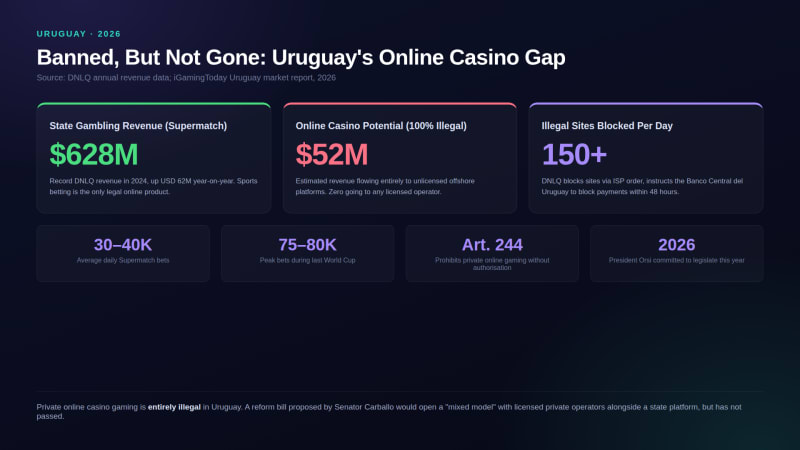
This chart shows Uruguay's USD 628 million in legal state gambling revenue next to the USD 52 million in estimated online casino potential currently flowing entirely to illegal offshore platforms.
The problem Uruguay faces is not that its legal market is failing. The problem is that an estimated USD 52 million in online casino revenue potential sits outside that legal market entirely, going to unlicensed offshore operators rather than any authorised Uruguayan entity. A reform bill from Senator Felipe Carballo, reintroduced in early 2026, proposes a "mixed model" that would allow licensed private operators to exist alongside a new state platform, backed by a dedicated national regulator and a bettor registry with spending limits. President Yamandú Orsi's government has committed to introducing a legislative package in 2026. No bill had passed as of this report.
Latin America Is Not a Regulated Region
Latin America's regulatory picture is one where the exception, a mature, nationally applicable online casino licensing framework, is treated as the regional norm when it is not. Only three markets have built one.
Colombia was the first, introducing its online gambling framework through Coljuegos in 2016. The Coljuegos framework covers all game types under a single B2C licence, with a 15% GGR tax for high-RTP games and roughly 16 active licensees today. Colombia's framework is the most established in the region, with nearly a decade of operational history behind it. Peru followed in February 2024, under Law No. 31557 and regulations administered by MINCETUR's Dirección General de Juegos de Casino y Máquinas Tragamonedas (DGJCMT). Brazil took effect on 1 January 2025, under Law 14.790/2023, with 78 federal licensees covering 138 brands onboarded within the first seven months. Brazil's framework requires local incorporation, biometric KYC, and Pix-based payments exclusively.
These three markets together cover approximately 299 million people, using World Bank 2024 population data, out of Latin America's roughly 662 million total. That leaves about 55% of the region's population in markets where online casino gaming is legally ambiguous, governed by a pre-internet statute, or simply absent from any current law.
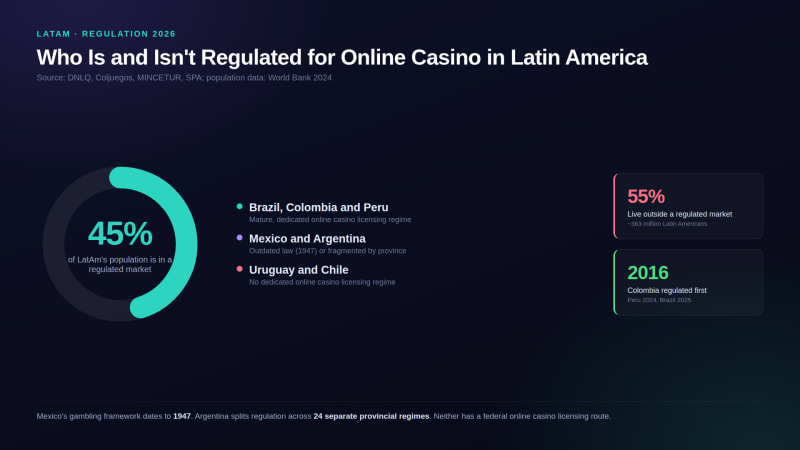
This chart shows that fewer than half of Latin America's population lives in a market with a functioning, dedicated online casino licensing regime.
A few things stand out from the comparative data:
- Colombia regulated a decade ahead of the rest. Its framework has time-tested stability that Brazil and Peru's newer systems are still building.
- Mexico's gambling law is 79 years old. The Ley Federal de Juegos y Sorteos was written in 1947, with no dedicated online casino licensing route added since, even as its legal online gambling market grew to approximately USD 2.7 billion in 2024.
- Argentina fragments regulation across 24 separate regimes. With no federal online gambling law, each of the 23 provinces plus the city of Buenos Aires sets its own rules, taxes, and licensing requirements independently.
- Chile has no comprehensive online gambling law in force. A bill has been pending since 2022, though the Senate approved it in general terms in August 2025 and the government gave it highest legislative priority in May 2026.
Regulation Is Only the First Layer
Online casino regulation is the structural layer of the localisation problem, but it is not the only one. Payment infrastructure fragments just as sharply across the region, and currency stability adds a third dimension on top of both.
Brazil's instant-transfer network Pix (Pagamentos Instantâneos) is the dominant payment channel for licensed betting there. An ENV Media survey of 654 adult respondents in Brazil found 81% preference for Pix, compared with 46% for bank cards. Pix is not only preferred but mandatory under Brazil's 2025 licensing framework, with credit cards and cryptocurrency banned for licensed operators. In Mexico, cash vouchers redeemable at OXXO convenience stores remain a primary deposit channel, since a significant share of the population does not use traditional banking for gambling transactions. In Colombia, bank transfers via the PSE (Pagos Seguros en Línea) network and cash payment through Efecty are the dominant methods. In Argentina, chronic inflation has pushed a meaningful share of gambling activity toward stablecoins, specifically USDT and USDC, as a hedge against the peso losing value between deposit and withdrawal.

This chart shows that no two major LatAm markets share the same primary gambling payment rail, making a single regional payments strategy structurally impossible.
A few things stand out from the payments data:
- Pix and OXXO cannot be used interchangeably. Pix requires a Brazilian CPF taxpayer identification number; OXXO requires physical access to a Mexican retail network. Neither works in the other country.
- Argentina's stablecoin adoption is a product of currency failure, not crypto enthusiasm. Stablecoins account for roughly 62% of all Argentine crypto transaction volume, per Chainalysis 2024 data, because the peso depreciates faster than players can withdraw in it.
- Uruguay's relevant payment rails are different again. RedPagos, a payment network native to Uruguay, and AstroPay, built specifically for Latin American players, are the relevant channels for the Uruguayan market once it opens.
Eddie Morales, Business Development Manager at Zenith, a platform serving more than 500 operators and 50 million players worldwide, addressed this payment fragmentation directly in an interview with CasinoRank.
"Payment behaviour, player psychology, acquisition economics, and regulatory frameworks differ significantly from country to country," Morales said. "A strategy that performs well in Peru can struggle badly in Brazil, and Mexico remains commercially attractive yet fragmented from both a regulatory and a payment perspective."
Language Is the Third Layer
Spanish itself is not uniform across Latin America, and the dialect gap between markets is the third localisation layer operators routinely underestimate. Uruguay and Argentina share Rioplatense Spanish, the linguistic variety built around voseo grammar. Rioplatense Spanish uses "vos" as the second-person singular pronoun in place of "tú," with its own conjugation set: "sos" instead of "eres," "tenés" instead of "tienes," "jugás" instead of "juegas." This is not a formal register; it is standard everyday speech, used in advertising, press, and official communications throughout Uruguay and Argentina. Content written in neutral Spanish or Mexican Spanish reads as distinctly foreign to a Rioplatense reader, regardless of how accurate its regulatory or payment content is. Numerical formatting adds a further distinction: Uruguay and Argentina use a period as the thousands separator and a comma as the decimal separator, the reverse of the convention used in the US and in much generic digital content.
What This Means in Practice
The three-tier regulatory map gives operators a genuinely useful planning framework rather than a single regional bet. Colombia, Peru, and Brazil reward operators who invest in full local compliance today, since the licensing infrastructure already exists and rewards early, properly localised entrants. Uruguay and Chile both reward operators who prepare compliance and country-specific localisation ahead of legislation that increasingly looks imminent. A dedicated regulator in Uruguay, Rioplatense voseo content, and a RedPagos integration are all achievable before the bill passes. Mexico and Argentina reward operators willing to work with local partners and a market-by-market payment strategy, since neither market will consolidate its regulatory fragmentation through a single federal fix in the near term.
Morales put the expansion sequence directly.
"The operators that succeed in LatAm focus on sequenced expansion intelligently and build scalable regional infrastructure," he told Yogonet in June 2026. "Using smaller and more efficient markets to build cash flow and expertise before committing heavily to large and more competitive jurisdictions like Brazil."
What to Do Next
- Classify every Latin American market you operate in or plan to enter by regulatory tier: regulated, fragmented, or absent, since each tier requires a fundamentally different entry and compliance strategy.
- Prioritise Colombia, Peru, and Brazil for full local compliance investment first, because the licensing infrastructure to support it already exists in all three markets.
- Track Uruguay's reform bill and Chile's fast-tracked legislation closely, and build country-specific compliance documentation, Rioplatense language assets, and local payment integrations before either passes.
- Match payment strategy to market specifically: Pix to Brazil, OXXO to Mexico, PSE to Colombia, and USDT support to Argentina's currency-instability reality.
- Localise language at the dialect level for Uruguay and Argentina: voseo conjugations, local currency formatting, and regionally familiar brand voice are not optional polish for either market.
Conclusion
Uruguay's prohibition on private online casino gaming reads as an isolated, conservative policy until it is placed next to the rest of the region. Once it is, it looks like the regional median rather than the exception. Fewer than half of Latin America's population lives in a market with a functioning online casino licensing regime, a state of affairs that makes the region's "single-market" reputation one of the most durable myths in iGaming expansion. The regulatory map, the payment map, and the language map all say the same thing: build for each country, not for the region.
"Latin America gets treated as a single expansion strategy far too often, and Uruguay shows exactly why that fails," says Elena Marsh, our Casino Content Analyst. "A market can have real player demand and still be almost entirely unregulated for online casino specifically. The operators who localise early own the player relationship when the licence finally comes."