Regulatory Titans: How AGCO and Lotto-Quebec Are Changing iGaming in Canada
 Jacob Mitchell
This article presents findings from OnlineCasinoRank research comparing how Canada’s two most influential regulatory frameworks—Ontario’s AGCO-led open market and Quebec’s Loto-Québec monopoly—shape the structure of the online casino industry and player access across provinces.
It examines how Ontario’s licensed, multi-operator model and Quebec’s single-operator system produce different outcomes in market competition, operator participation, and player experience. The analysis focuses on how each framework impacts industry development, regulatory compliance requirements, and the availability and quality of online casino platforms for Canadian players.
The History of Canadian iGaming Regulations
Canada banned gambling at the federal level until the 1970s, when provinces took control of regulation. That’s when provincial lotteries and real money casinos started expanding. Online gambling appeared in the late 1990s, but each province handled it differently. Quebec launched one of the first government-run gambling sites, while most provinces moved slowly. In 2022, Ontario became the first province to open a regulated iGaming market for private operators under AGCO oversight.
Overview of Canada’s iGaming Frameworks
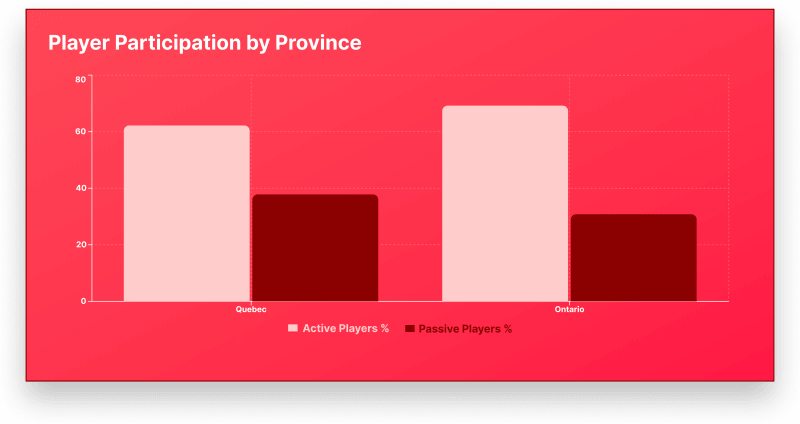
Canada's gambling regulatory framework operates under a provincial model, with each jurisdiction implementing its own approach. According to Casino Industry News, approximately 64.5% of Canadians under 24 years old participated in some form of gambling in 2024, with participation rates and Canadian player preferences varying by province.
Quebec leads with a 69.1% participation rate, while Ontario reports 62.2% - a notable difference that reflects distinct regulatory environments and cultural attitudes. Men consistently show higher participation rates across all provinces, with 68.8% nationally compared to 60.4% for women.
Ontario’s market generated CA$2.9 billion in gaming revenue in 2024–25, up 31% year over year,” according to iGaming Ontario’s annual report, showing how quickly regulated platforms have expanded since the province opened the market in 2022.
AGCO: Ontario Regulations Exlained
Ontario made history in April 2022 by becoming Canada's first province to establish an open, regulated iGaming market. Under this model, the AGCO serves as the primary regulatory body while iGaming Ontario (iGO) – recently separated into a distinct agency – operates as a subsidiary focused on managing operator agreements. The AGCO model features several distinctive characteristics:
- Competitive Licensing: Private operators can apply for licenses, creating a competitive marketplace with over 70 licenses issued since April 2022. This open structure has encouraged innovation, marketing diversity, and international investment.
- Revenue Generation: The market reported $2.4 billion in gaming revenue for fiscal year 2023–2024, with 1.3 million active player accounts during Q4. Ontario’s model has outperformed expectations, demonstrating the commercial viability of a well-regulated, competitive framework.
- Geographical Limitations: Players may access licensed platforms only while physically located within Ontario. Geolocation and identity verification technologies are mandatory to enforce this rule.
- Mandatory Registration: All operators must register with the AGCO to ensure compliance with provincial standards. Online casino licensing criteria emphasize consumer protection, anti-money laundering measures, and responsible gambling safeguards. Online casino activity has seen significant growth since regulation, with the open market attracting major global operators and substantial investment. This model is now seen as a benchmark for potential regulation in other provinces exploring market liberalization.
What this Means for the iGaming Industry: For the iGaming industry, Ontario’s framework is important because it created a replicable regulatory model combining open competition with strict enforcement. It sets a benchmark for how jurisdictions can legalize online gambling while controlling risk, licensing, and market entry.


Loto-Québec Regulations Explained
In stark contrast to Ontario's approach, Quebec maintains a government monopoly model through Loto-Québec, a crown corporation established in 1969. This organization oversees all forms of gambling within the province, including the Espacejeux online platform, which operates as the exclusive legal channel for internet-based wagering. Key aspects of Quebec's regulatory approach include:
- Government Monopoly: Loto-Québec is the sole authorized provider of online gambling services. Private operators are prohibited from entering the market, preserving centralized control over content, marketing, and platform management.
- Revenue Allocation: Profits generated through Loto-Québec directly support provincial programs and services, including healthcare, education, and infrastructure. This ensures gambling proceeds are reinvested for public benefit rather than private profit.
- Integrated Responsible Gambling: Centralized oversight enables province-wide implementation of responsible gambling measures, including self-exclusion tools, spending limits, and educational campaigns, under the "Jeu responsable" program.
- Lower Age Requirement: Quebec permits gambling at age 18, compared to Ontario's minimum age of 19. This aligns with the province's broader age-of-majority policies and contributes to earlier market engagement. Quebec's gambling participation rate of 69.1% exceeds the national average, suggesting that the monopoly model has not discouraged consumer interest. Instead, it demonstrates that a well-managed public system can coexist with high engagement while retaining strong regulatory safeguards and societal returns.
What this Means for the IGaming Industry: It allows experts to determine whether a market is licensable (Ontario model) or restricted monopoly (Quebec model), which directly affects entry strategy. It also defines required compliance systems (KYC, AML, geolocation, reporting) needed before launch. It reduces regulatory failure risk by aligning products, payment methods, and operations with provincial enforcement rules, preventing license rejection or market exclusion.

Types of Regulations Across Canadian Regions
Canadian gambling regulation is fully provincial, so each region controls licensing, access, and market structure independently. This creates four main regulatory models across the country.
Saskatchewan
Saskatchewan uses a mixed public–First Nations model. The province works with the Saskatchewan Indian Gaming Authority (SIGA), which co-manages land-based gaming operations. In 2022, Saskatchewan also introduced a regulated online gambling option through a partnership model. The structure combines provincial control with First Nations revenue participation.
Atlantic Provinces
The Atlantic region (Nova Scotia, New Brunswick, Newfoundland and Labrador, Prince Edward Island) uses a centralized public operator model through the Atlantic Lottery Corporation (ALC). ALC is the only legal online gambling provider in the region. There is no private operator market, and online offerings are limited compared to competitive provinces.
British Columbia, Manitoba, Alberta
These provinces use government-run monopoly platforms. British Columbia and Manitoba operate through PlayNow via provincial lottery corporations, while Alberta uses PlayAlberta under the AGLC. Private operators are generally excluded, and all legal online gambling is run by provincial agencies with integrated responsible gambling and revenue control systems. Alberta is also moving toward opening its market to private operators.
Territories (Yukon, Northwest Territories, Nunavut)
The territories have minimal formal online gambling regulation. There are no fully developed provincial-style online platforms. Residents mainly access gambling through limited lottery services or offshore websites, as regulatory infrastructure and population size have not supported large-scale local platforms.

How iGaming Regulations Affect Canadian Players
Key Points:
- Access depends on province
- Ontario: multiple licensed operators, regulated market
- Other provinces: government platforms or limited legal options
- Game choice and competition
- Open markets = more casinos, more game variety
- Monopoly markets = fewer platforms, standardised offerings
- Player protection level
- Licensed markets enforce KYC, AML, and responsible gambling tools
- Protection is weaker or inconsistent outside regulated systems
iGaming regulations play a pivotal role in shaping the experience of Canadian online casino players. In provinces like Ontario, where the industry is formally regulated, players benefit from increased choice, stronger consumer protections, and access to reputable international operators. Licensed platforms must meet strict standards for fairness, security, and responsible gambling, which helps build player trust and reduce risks associated with unregulated sites.
Regulation also shapes the promotional landscape, influencing the availability and structure of casino bonuses across different provinces in Canada.
On the other hand, in provinces with limited or centralized iGaming frameworks—such as Quebec—players may find fewer options but more consistent oversight, often tied to government-run platforms. These regulatory differences directly impact how easily players can access various online casino games, the quality of those platforms, and the safeguards in place to protect them. As more provinces consider regulatory reform, Canadian players could see broader access and higher standards across the board, making regulation not just a legal issue but a key factor in shaping the overall quality of online casino platform play.


What are the differences between AGCO & Loto-Québec?
The contrast between Ontario's open market and Quebec's crown corporation model highlights fundamental differences in regulatory philosophy:
Aspect | Ontario (AGCO) | Quebec (Loto-Québec) |
|---|---|---|
Market Structure | Competitive, multi-operator | Government monopoly |
Licensing Approach | Multiple private licenses | Single crown corporation |
Revenue Model | Tax on operator revenue | Direct government profits |
Player Accounts | 1.3 million active (Q4 2023-24) | Not publicly disclosed |
Age Requirement | 19 years | 18 years |
Regulatory Focus | Operator compliance, player protection | Centralized control, public benefit |

Conclusion
Ontario and Quebec have taken divergent yet effective paths in regulating gambling. Ontario’s open-market strategy has attracted global operators, spurred competition, and expanded consumer choice. In contrast, Quebec’s centralized model prioritizes consistent oversight and channels revenue into public services.
Both systems are proving viable, with Ontario seeing growth in online casino activity and Quebec maintaining steady participation. Rather than pointing to a single "best" model, these approaches reflect differing provincial priorities—and both may hold lessons for future regulatory frameworks.
Considering the continued growth of Canada’s iGaming industry, the strengths of each system could inspire hybrid models elsewhere. For now, AGCO and Loto-Québec remain the leading examples of how different regulatory philosophies can coexist and succeed in shaping the future of gambling.