What Alberta’s Online Gambling Market Is Likely to Look Like Next


Recommended casinos
Alberta is moving from a single regulated online gambling platform to a competitive model. Until now, regulated online gambling in the province has effectively meant one option: PlayAlberta, overseen by the Alberta Gaming, Liquor and Cannabis Commission (AGLC).
That is about to change, as Alberta enacted the iGaming Alberta Act, which establishes the legal foundation for a broader, regulated online gambling ecosystem and sets the framework for an iGaming corporation working alongside the regulator.
To understand what this shift means in real life, there is one Canadian comparator that matters more than all others. Ontario is the only province operating an official competitive iGaming market that licenses multiple private operators under a defined regulatory regime.
This guide explains, in plain terms, how Alberta’s model is changing, why Ontario is the benchmark, and what players should reasonably expect once Alberta’s market opens. It also includes CasinoRank’s proprietary analysis using iGaming Tracker exports to illustrate differences in game catalog breadth and supplier mix across provinces.
Alberta’s Online Gambling Model Until Now
Today, I tabled Bill 48: the iGaming Alberta Act, that would establish the framework for a safer and regulated online gaming market in our province.
More here: https://t.co/XDaI3rru5V pic.twitter.com/ms4phCMvbg
— Dale Nally (@DaleNally_AB) March 26, 2025
What Alberta had
PlayAlberta has anchored Alberta’s regulated online gambling experience. PlayAlberta describes itself as Alberta’s only regulated online gambling site and references AGLC oversight and responsible gambling tools.
This structure is simple to understand:
- One regulated platform
- One set of product decisions
- One user experience
- One place where regulated online gambling revenue is routed
Why that matters
A single-platform model offers clear control, but it does not create competition inside the regulated market. When there is no regulated competition, players who want different products, features, or brand experiences often find alternatives outside the regulated system. Alberta policymakers have discussed this challenge in the context of widespread availability of unregulated or grey-market sites.
The key point for readers is this:
- Alberta did not lack online gambling demand
- Alberta lacked regulated variety
What the iGaming Alberta Act Actually Does
The iGaming Alberta Act is the legal foundation for Alberta’s new structure. The Act is in force as a provincial statute, and the legislative text outlines an iGaming corporation and information-sharing relationship with the Commission.
The easiest way to understand the new model
Think of the new model as two lanes:
- The regulator lane (AGLC): AGLC continues to oversee gaming regulation, which includes compliance, standards, and enforcement related to gaming activities.
- The market-operations lane (iGaming corporation): The Act contemplates an iGaming corporation working in tandem with the regulator, with information-sharing provisions set out in the legislative text.
Why governments split the roles
When a province wants a competitive market but also wants consistent standards, it usually separates:
- Compliance and enforcement (regulator)
- Market operations and commercial coordination (market manager)
Ontario uses this separation, which is part of why it is the clean comparator for Alberta’s next phase.
Ontario is the Only Canadian Competitive iGaming Market
This needs to be stated plainly because it is where people get confused.
What Ontario has that other provinces do not
Ontario operates an open, competitive iGaming market. iGaming Ontario’s own reporting describes an “open competitive market” and publishes market performance results.
Ontario also has defined regulatory standards for internet gaming through the Registrar’s Standards for Internet Gaming issued by the AGCO.
What British Columbia and Quebec have instead
British Columbia and Quebec offer legal online gambling through government-linked platforms, not an open, competitive licensing model.
- British Columbia: PlayNow is operated by the British Columbia Lottery Corporation and is presented as the official gaming site for BC residents.
- Quebec: Loto-Québec operates an official online gaming platform (EspaceJeux portal).
These are legal online gambling ecosystems, but not competitive markets like Ontario.
What Numbers Show
Ontario’s reported results provide the clearest evidence of scale when competition operates under regulation.
iGaming Ontario reported that, in its third year, Ontario’s market resulted in $82.7 billion in wagers and $3.2 billion in gross gaming revenue.
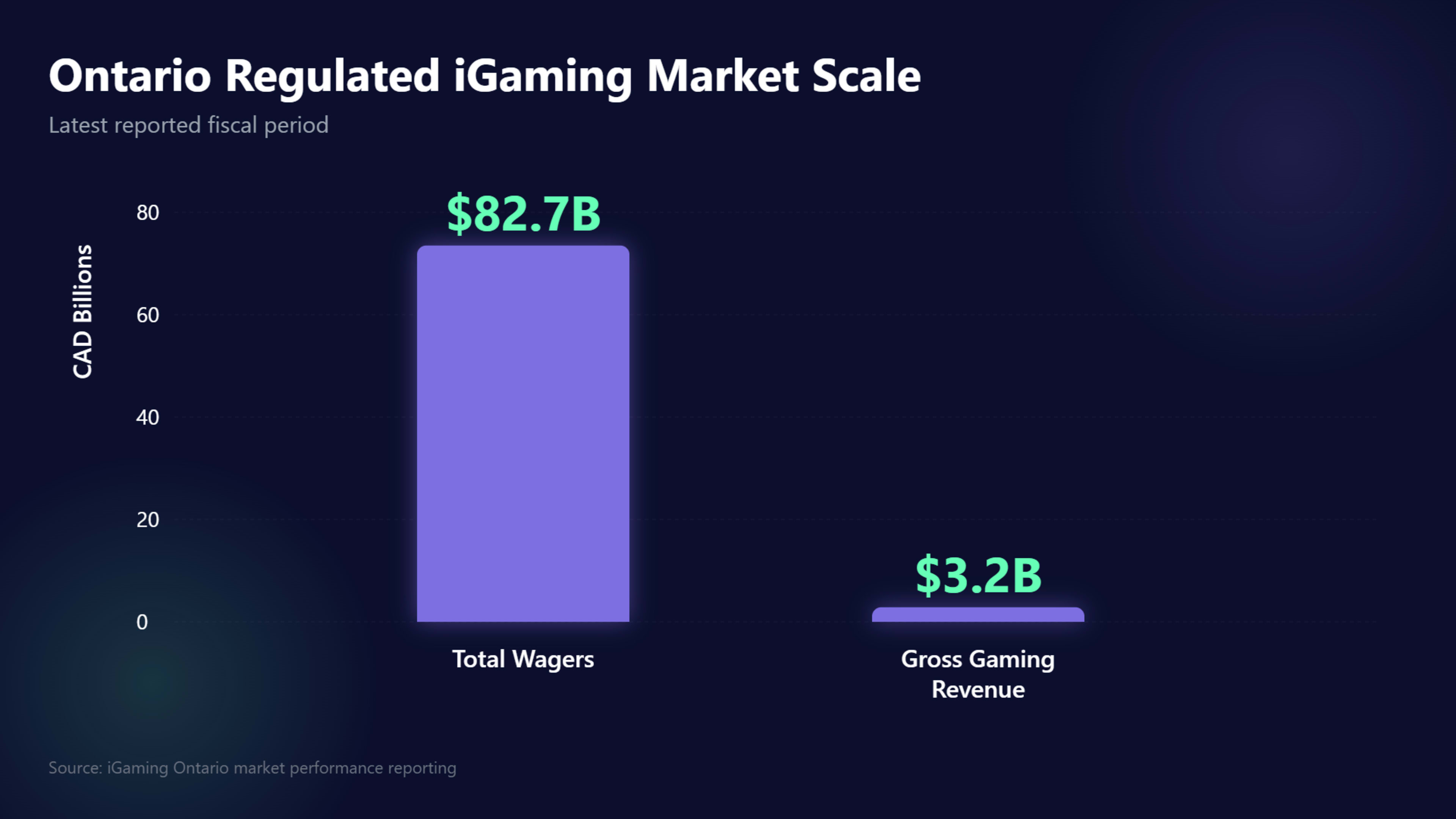
This chart illustrates the scale of Ontario’s regulated iGaming market, showing total wagers and gross gaming revenue for the latest reported fiscal period. The data demonstrates how a competitive regulated framework can operate at a significant scale while remaining under provincial oversight.
Why these numbers matter for Alberta readers
Those figures show:
- A regulated market can operate at national-scale levels
- Competition does not prevent oversight
- Regulated participation can be sustained beyond launch hype
The Rules Layer: How Ontario Maintains Control Even With Competition
Readers often assume a competitive model means the province “steps back.” Ontario is proof that the opposite can be true. Ontario’s market operates inside a detailed compliance framework, including AGCO’s Registrar’s Standards for Internet Gaming.
At a high level, those standards are organized across risk themes and provide a structured compliance baseline for regulated internet gaming sites.
What this implies for Alberta
Because Alberta is adopting a similar split between regulator and market operations in its new framework, the practical expectation is:
- Multiple brands can exist
- Standards can remain centralized
- Player protections can remain mandatory
This is not a promise of outcomes. It explains how the model works when implemented as designed.
CasinoRank Data Analysis Using iGaming Tracker
This section uses CasinoRank’s study based on iGaming Tracker exports that include monthly columns and an aggregate field labeled “Total” for each title. This is used here to compare catalog breadth and supplier mix, not to claim official operator licensing or regulated market competitiveness outside Ontario.
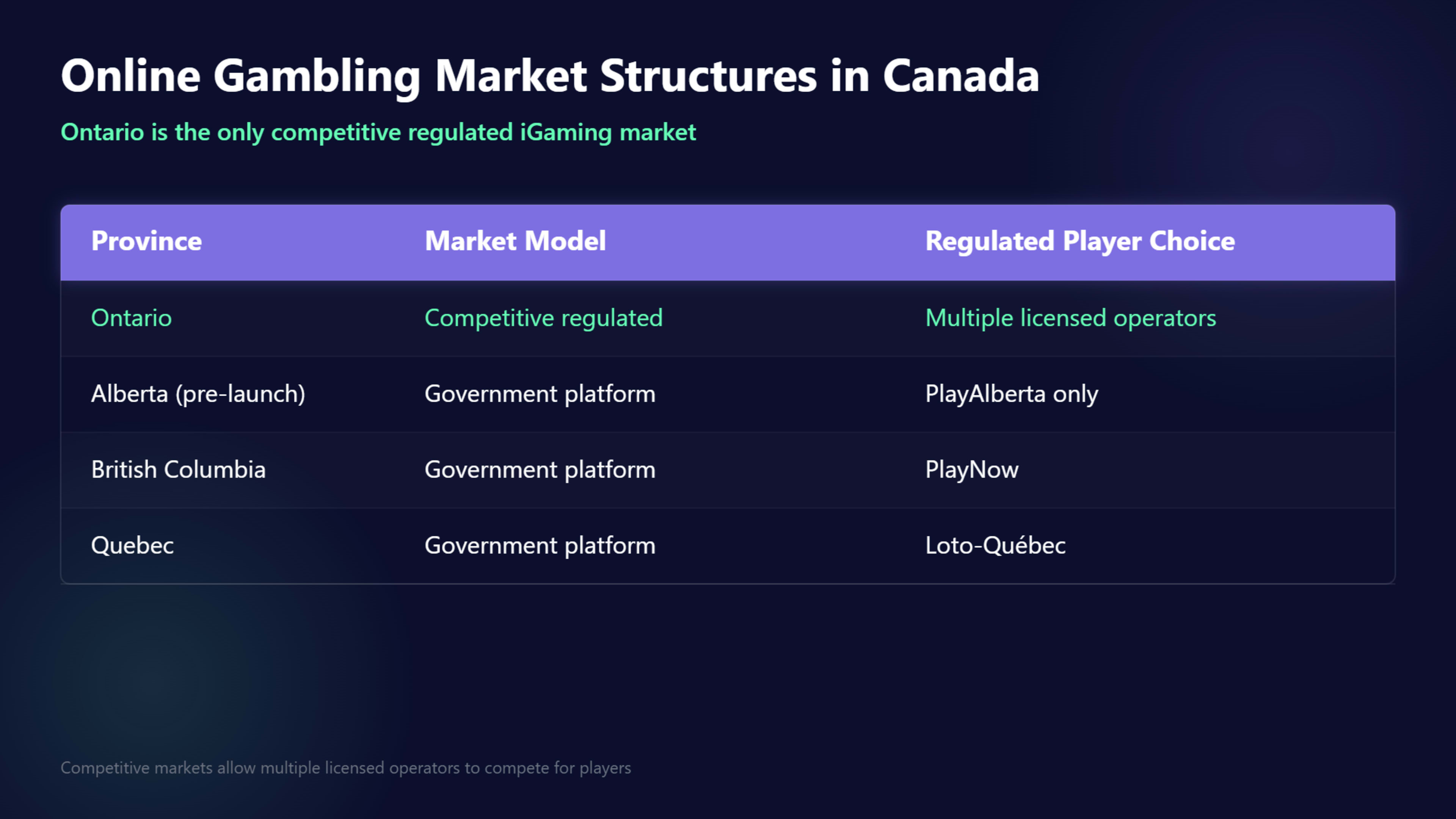
This table outlines the structural differences between Canadian online gambling models. Ontario is currently the only province with a competitive regulated iGaming market that licenses multiple private operators. Alberta, British Columbia, and Quebec operate government platform models, offering regulated access without internal market competition.
What CasinoRank measured (and what it did not)
- Measured: number of unique game titles and suppliers appearing in the export per province, plus top suppliers by aggregate Total score
- Not measured: licensing status of private operators in BC and Quebec
- Not claimed: that BC or Quebec are competitive iGaming markets
Catalog breadth snapshot
Based on CasinoRank analysis of iGaming Tracker exports:
- Ontario: 11,241 unique games; 284 unique suppliers
- British Columbia: 820 unique games; 45 unique suppliers
- Quebec: 16,129 unique games; 408 unique suppliers
Important note for readers: These counts reflect what is captured in the CasinoRank dataset exported for analysis. They are not official inventory statements from the regulator.
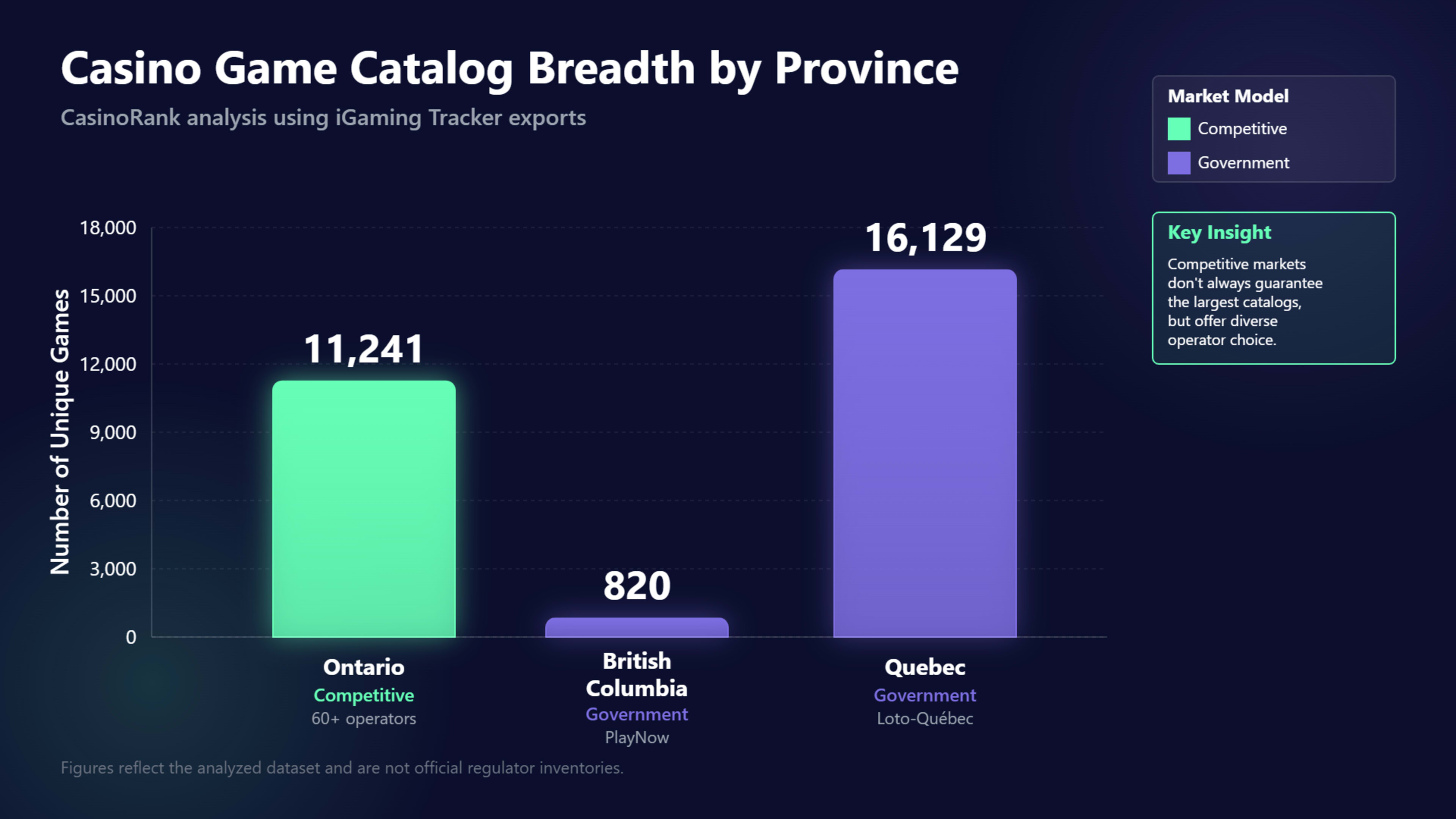
This visualization highlights differences in the number of unique casino games available by province. Ontario’s competitive market offers a broad catalog driven by multiple licensed operators, while British Columbia and Quebec rely on centralized government platforms. Figures are based on CasinoRank analysis of iGaming Tracker exports and represent dataset coverage, not official regulator inventories.
Supplier concentration signals (why this matters)
Casino catalog depth and supplier diversity often correlate with:
- game variety
- localization opportunities
- format diversity such as live dealer, RNG table, slots
CasinoRank’s export analysis shows that, in Ontario, the top suppliers by aggregate Total score include Games Global, Evolution, Pragmatic Play, Playtech, and Play’n GO. In British Columbia, IGT and Light and Wonder dominate the supplier list by aggregate Total score. In Quebec, Games Global, Playtech, Spinomenal, Pragmatic Play, and Evolution rank highly by the same aggregate measure.
This matters because, as Alberta moves toward a multi-operator model, a typical pattern is that:
- Competition expands catalog diversity over time
- Suppliers diversify as brands differentiate
Disclaimer: We do not state this as guaranteed. We state it as a consistent competitive-market pattern illustrated most clearly by Ontario’s model and standards environment.
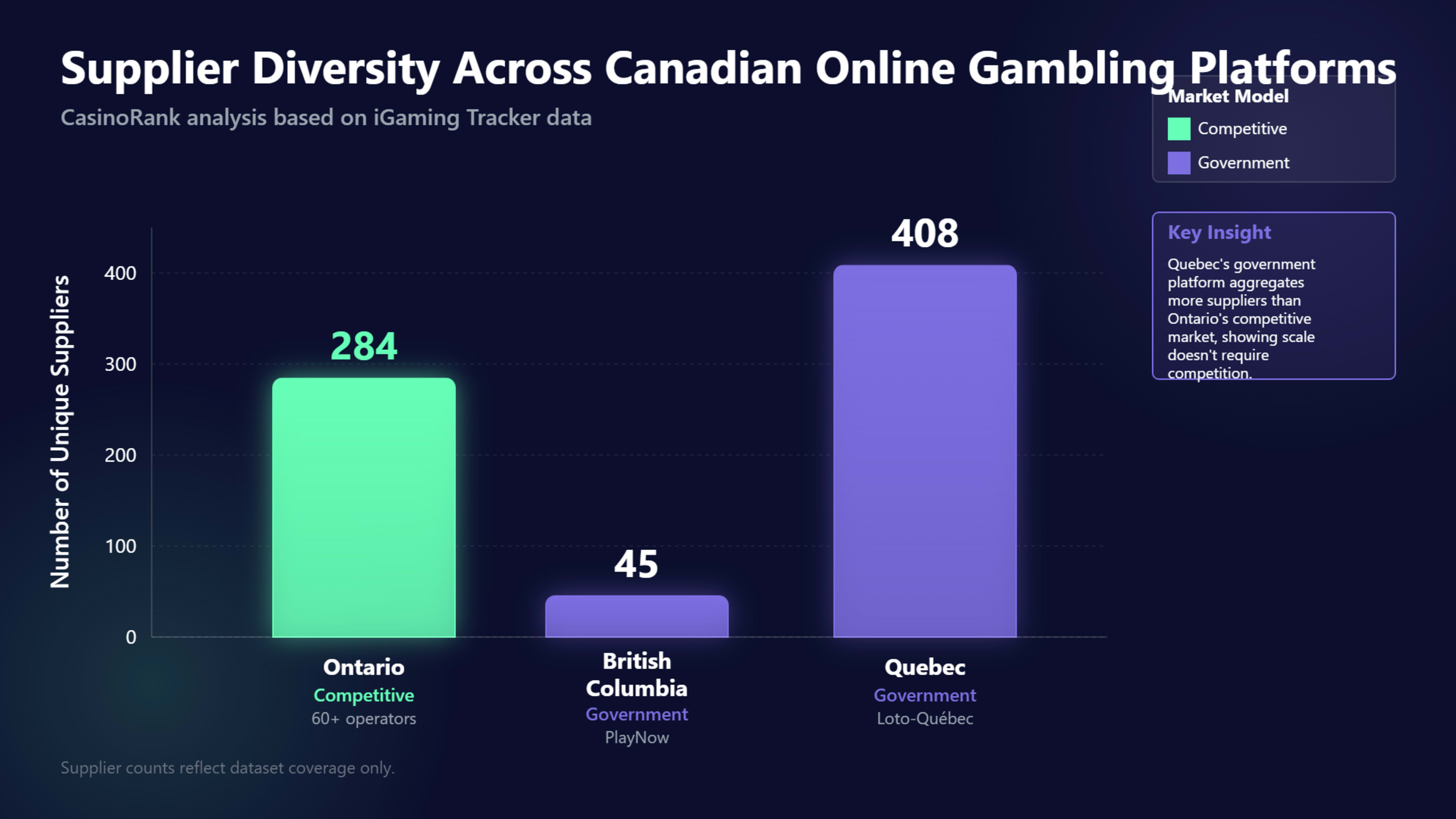
This chart compares the number of unique game suppliers available across Canadian online gambling platforms. Ontario, the only competitive regulated iGaming market, supports a broad supplier ecosystem, while British Columbia and Quebec operate government-run platforms with different aggregation models. Supplier counts reflect CasinoRank's analysis of iGaming Tracker data and indicate catalog structure rather than licensing status.
What Alberta Players Should Expect, Explained in Plain Language
As Alberta moves into an opening phase, the key changes people should understand are operational, not just legal.
1. More regulated choice
Ontario’s market demonstrates what it means when multiple regulated options exist: different platforms, different game catalogs, different product designs, all under common rules.
2. Standardized protections across brands
Ontario’s standards framework shows how a regulator can require consistent protection controls even across many operators.
3. The market will not look “finished” on day one
Ontario’s current scale is the outcome of multiple years of operation and market maturation. That is visible in iGaming Ontario’s year-three reporting language and performance framing.
Where British Columbia and Quebec Help Set Expectations
BC and Quebec are useful because they show what a government-platform-only model looks like. They are not predictive of Alberta’s competitive model, but they help explain why provinces change course.
- PlayNow is positioned as BC’s official site operated by BCLC.
- Loto-Québec positions its online platform as legal and official.
The lesson for readers is straightforward:
- A legal platform can exist without competition
- Alberta is transitioning away from that structure
- Ontario shows the operational blueprint for a regulated competitive market
Conclusion
Alberta’s online casino market is entering a new era. The province is moving from a single regulated platform toward a competitive model under provincial oversight. The only Canadian example of that structure operating at full scale is Ontario, which has published market performance results and maintains a formal standards framework for internet gaming.
British Columbia and Quebec are helpful contexts because they illustrate government-platform legal models, not because they predict competitive outcomes.
For readers, the message is simple and factual: Ontario shows what competition under regulation looks like in Canada, and Alberta’s approved framework is designed to move the province in that direction.
Sources and Data Notes
- Alberta Legislative Assembly (iGaming Alberta Act).
- Alberta Gaming, Liquor and Cannabis Commission (AGLC) official site.
- PlayAlberta's statements on being the only regulated site in Alberta.
- iGaming Ontario year-three market performance reporting ($82.7B wagers, $3.2B GGR).
- AGCO Registrar’s Standards for Internet Gaming.
- PlayNow official site and BCLC context.
- Loto-Québec official online platform (EspaceJeux portal).
Data note (CasinoRank research): Catalog breadth and supplier mix comparisons (unique games, unique suppliers, top suppliers by aggregate dataset “Total”) are based on CasinoRank analysis of iGaming Tracker exports. These figures describe the exported dataset analyzed and are not presented as official regulator inventory reporting.