Sweepstakes casinos keep beating traditional iGaming brands for US demand
 Jacob Mitchell
Blask data shows just how large the sweepstakes segment really is in the US iGaming market.
Across January–May 2026, nationwide interest in sweepstakes brands outpaced traditional iGaming operators combined. Sweepstakes lose the demand battle only in 15 states — and even there, licensed onshore brands clear 50% of the combined Blask Index in just 4 of them. Here's what the numbers show state by state.
Sweepstakes keep the upper hand
The legal US iGaming industry isn't just losing users to offshore books and prediction markets — sweepstakes casinos are beating them too. It's grey-area model is now squarely in regulators' crosshairs, with a wave of explicit state bans starting last year.
Sweepstakes casinos run casino-style games under promotional sweepstakes law. Players buy Gold Coins to play, and get Sweeps Coins free as a bonus — only the Sweeps Coins can be cashed out. Because the redeemable currency is always obtainable for free, no purchase is ever technically required to play for real prizes, which is how the model sidesteps the legal definition of a wager. Regulators increasingly disagree, and sweepstakes are already banned outright in several states.
Blask Index puts sweepstakes brands' share of combined US demand at 57.9% for January–June 2026, clear majority territory. That dominance shows up at the very top of the leaderboard: more than half of the nationwide top 10 by demand, including the #1 spot, are sweepstakes brands.
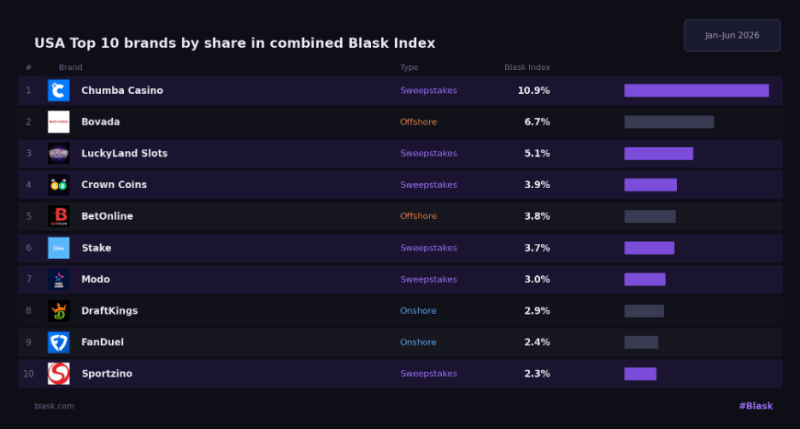
Chumba Casino leads the pack at 10.9%, followed by LuckyLand Slots and Crown Coins. The highest-ranking non-sweepstakes brands are offshore — Bovada at 6.7% and BetOnline at 3.8%. The two biggest licensed operators — DraftKings and FanDuel — only rank 8th and 9th, and together they still don't add up to half of what Chumba alone commands.
Where traditional brands still hold the line
State by state, sweepstakes brands out-index traditional operators in 35 jurisdictions. The remaining 15 states split across three different regulatory setups.

In 13 of those 15, sweepstakes are banned or restricted outright. Only two states have legal sweepstakes that still lose the demand battle: Pennsylvania and Hawaii. These markets couldn't be more different — Hawaii has no legal traditional iGaming at all, while Pennsylvania runs a fully open, regulated market.
Even in Pennsylvania, without active enforcement against sweepstakes, licensed brands can't win a majority of user demand the way they do in Michigan, New Jersey, Connecticut and Delaware. Those four are the only states where onshore operators alone outdraw offshore and sweepstakes brands combined.
Bottom line
Blask's sweepstakes analytics adds a missing layer to the US iGaming picture — showing not just how much demand leaks offshore, but where the rest of it lands in this grey-area segment. The data makes one thing clear: a competitive licensed market paired with real enforcement can pull demand back onshore. Without that combination, sweepstakes casinos take the market almost by default.
About Blask
Blask is an AI-powered platform for iGaming and gambling market analytics. The company turns fragmented open-source signals into real-time insight on brand visibility, player demand, and baseline revenue metrics, helping teams move first, spend smarter, and reduce risk across global markets.