Online Casino Wordlist: Terms, Slang & Finance Explained
 Jacob Mitchell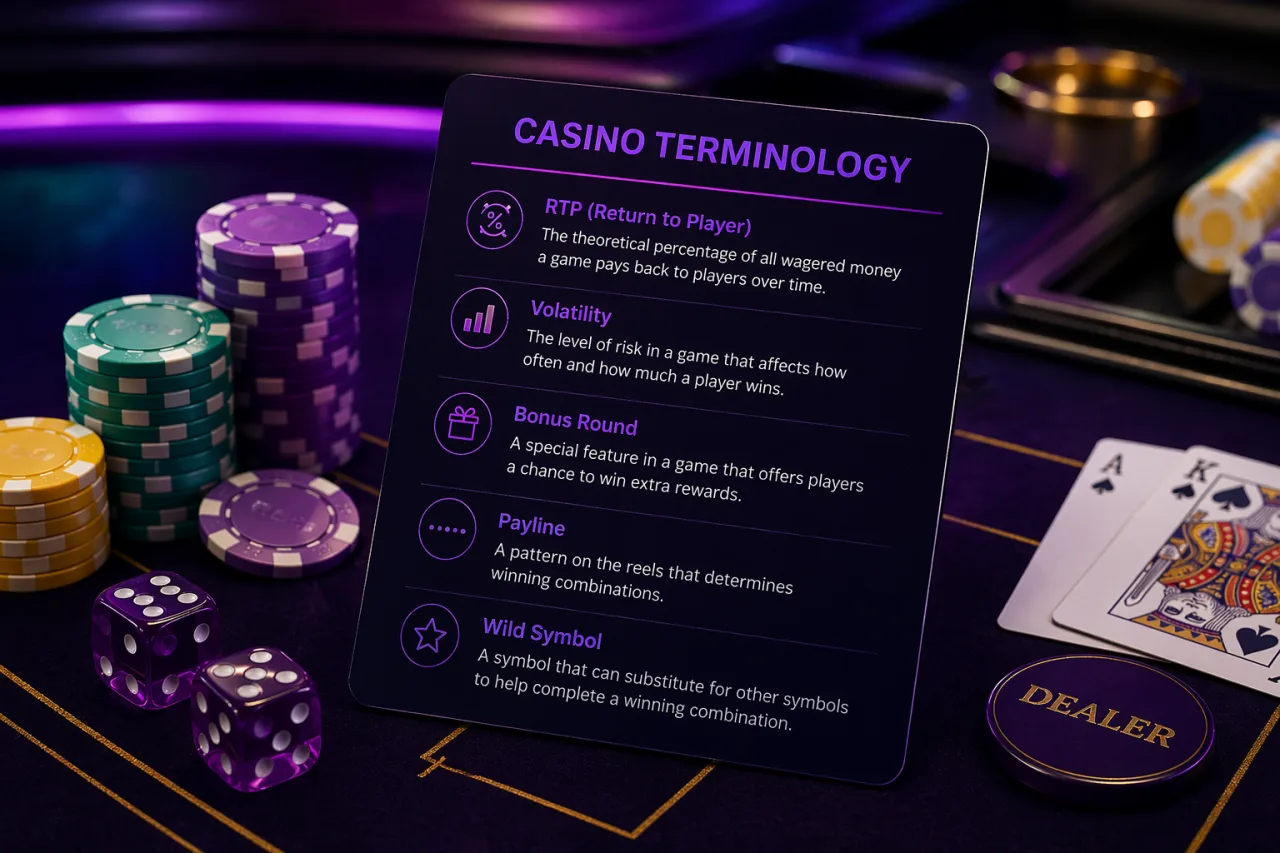
This online casino wordlist is a structured reference that covers the core terms, bonus and game-specific vocabulary, community slang, and gambling industry finance terminology that players and industry observers encounter most often.
The wordlist is built for two types of readers. New players can use it to make sense of the language that appears on casino sign-up pages, bonus terms, game lobbies, and review articles. Experienced players can use it to understand the business and financial side of the operators they play at, including the terminology used in earnings reports, SEC filings, and stock exchange listings for publicly traded gambling companies.
The content is organized into eight categories: core casino terms, bonus and promotion terminology, slot game terminology, table game and live dealer terminology, payment and banking language, regulatory and responsible gambling terms, player slang, and casino industry finance terms. Each category is arranged alphabetically within itself, so readers looking for a specific term can scan the relevant section directly. For readers who already know which term they need, using Ctrl+F on a desktop or the find-in-page function on mobile is the fastest way to locate a definition.
Core Online Casino Terms Every Player Should Know
These are the foundational terms that appear across almost every online casino, bonus page, and review article. New players should read these first, as the rest of the wordlist builds on them.
- Bankroll is the total amount of money a player has set aside for gambling activity. It is separate from a player's general finances and is intended to be used only for wagers. Managing the bankroll responsibly is one of the core principles of informed play.
- Bet is the amount of money a player risks on a single wager. A bet has a fixed stake, a defined outcome, and a known payout structure determined by the rules of the game.
- Casino lobby is the main screen or page where an online casino displays its games. A lobby is typically organized into categories such as slots, table games, live dealer, and instant-win, allowing players to browse by game type or by provider.
- House edge is the mathematical advantage that a casino holds over the player on any given game, expressed as a percentage. European roulette carries a house edge of 2.70%, while American roulette carries a house edge of 5.26%. House edge is the inverse of the game's payout percentage over time.
- iGaming is the industry term for online gambling, covering online casinos, sports betting, poker, bingo, and lottery. iGaming is the shorthand used in commercial, regulatory, and trade-press contexts to refer to the sector as a whole.
- KYC (Know Your Customer) is the identity verification process that licensed casinos are required to complete before releasing withdrawals. KYC involves the submission of government-issued photo ID, proof of address, and, in some cases, proof of the source of funds. KYC is a regulatory requirement designed to prevent fraud and money laundering.
- Payout is the amount a player receives after a winning bet, including the original stake. A payout is expressed either as a fixed amount or as a multiple of the stake, depending on the game.
- Payout percentage is the overall percentage of total wagers that a casino returns to players as winnings over a given period. Payout percentage is usually published in operator transparency reports and is the aggregate figure across all games offered.
- RNG (Random Number Generator) is the software system that produces the outcomes of games at RNG-based online casinos. RNGs are tested by independent laboratories such as GLI, iTech Labs, and eCOGRA to confirm that results are statistically random and cannot be predicted or manipulated.
- RTP (Return to Player) is the theoretical long-run percentage of wagered money that a game pays back to players. RTP is calculated over millions of simulated rounds and is typically published by the game's provider. A slot with an RTP of 96% returns €96 for every €100 wagered over the long term. See our comprehensive guide on the RTP in online casinos.
- Stake is the amount a player places at risk on a single round of play. Stake is used interchangeably with the term bet, though "stake" appears more often in bonus terms and wagering requirement calculations.
- Variance is the statistical measure of how far actual results deviate from expected results over a given number of rounds. Variance is why short-session outcomes can differ dramatically from a game's published RTP, even though the long-run average holds.
- Wager is a synonym for bet, used most often in regulatory and bonus-related contexts. A wagering requirement, for example, measures the total amount a player must bet before bonus funds become withdrawable.
- Welcome offer is the introductory bonus package that an online casino provides to new depositing players. A welcome offer commonly includes a deposit match, free spins, or both, and is subject to wagering requirements and other terms documented in the casino's promotions section.
Bonus and Promotion Terminology
Bonus terms are the area where new players most often run into unexpected conditions. Understanding the vocabulary used in bonus offers before accepting one can prevent locked funds, forfeited winnings, and wagering traps.
- Cashback is a bonus that refunds a percentage of a player's net losses over a defined period. Cashback bonuses are typically paid as real-money credit with no wagering requirements, though some operators classify them as bonus funds that must be wagered before withdrawal.
- Deposit bonus is a promotional credit awarded to a player who deposits funds into their casino account. A deposit bonus is expressed as a percentage match of the deposit amount, up to a defined cap, and is subject to the operator's wagering requirements.
- Free spins are slot-round credits that do not deduct from the player's real-money balance. Free spins are tied to a specific slot or a small set of eligible slots, and winnings from free spins are usually treated as bonus funds subject to wagering requirements.
- Loyalty program is a structured rewards system that compensates players based on their wagering volume over time. A loyalty program typically includes tier levels, point accrual per wager, and rewards that range from cashback and free spins to personal account managers and exclusive promotions.
- Matched deposit is a deposit bonus in which the casino matches the player's deposit by a fixed percentage. A 100% matched deposit doubles the deposited amount as bonus funds, while a 200% matched deposit triples it.
- Max cashout is the maximum amount a player can withdraw from winnings generated through a bonus. Max cashout applies regardless of how much the bonus actually produces, so a bonus with a €100 max cashout caps withdrawable winnings at that figure, even if the player has accumulated more.
- No-deposit bonus is a bonus awarded to a player without requiring a prior deposit. No-deposit bonuses are usually small in value, come with strict wagering requirements, and often include a max cashout limit that caps the total amount withdrawable.
- Reload bonus is a deposit bonus offered to existing players who add funds to their account after the initial welcome period. Reload bonuses are generally smaller in percentage and value than welcome offers and may be tied to specific deposit days or player tiers.
- Sticky bonus is a bonus that cannot be withdrawn under any circumstances. Only the winnings generated from wagering the sticky bonus are eligible for withdrawal, and the bonus amount itself is removed from the balance once wagering is complete.
- T&C (Terms and Conditions) is the legal document that defines the rules governing a bonus or promotion. T&C covers wagering requirements, eligible games, maximum bet limits, expiration dates, and withdrawal restrictions, and should be reviewed in full before a player accepts any bonus.
- VIP program is the top tier of a casino's loyalty structure, reserved for players with high wagering volumes. A VIP program offers enhanced benefits such as personal account managers, faster withdrawals, tailored bonus offers, and, in some cases, real-world rewards like event invitations or branded merchandise.
- Wagering requirement is the multiplier that defines how much a player must wager before bonus funds become withdrawable. A 35x wagering requirement on a €100 bonus means the player must place €3,500 in qualifying wagers before any bonus winnings can be withdrawn.
- Zero wagering is a bonus structure that carries no wagering requirement. Zero wagering bonuses allow players to withdraw winnings immediately, though they are often smaller in size than bonuses with standard wagering attached.
Table Game and Live Dealer Terminology
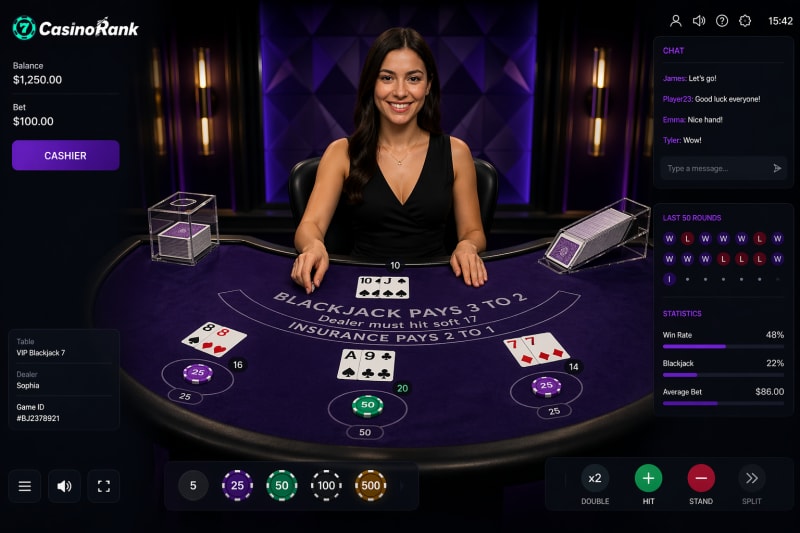
Table games and live dealer formats share a vocabulary that differs from slots in both structure and strategy. These are the core terms used in blackjack, roulette, baccarat, poker, and their live dealer variants.
- Ante is an initial bet that a player must place before a hand begins. Ante is required in poker-based games such as Casino Hold'em and Three Card Poker, and in some blackjack variants where it serves as the base wager that qualifies the player for the round.
- Dealer is the person responsible for running a table game in live dealer formats, or the software-controlled equivalent in RNG table games. A live dealer deals cards, spins the roulette wheel, manages bet timers, and handles payouts, while an RNG dealer performs these functions through an animated interface.
- Double down is a blackjack option that allows a player to double the original bet in exchange for receiving exactly one additional card. Double down is typically offered only on the first two cards of a hand and, in some rule variants, is restricted to hands totaling 9, 10, or 11. Read our guide to learn how to master blackjack double down.
- Insurance is a side bet in blackjack that protects a player against the dealer holding a natural blackjack when the dealer's visible card is an ace. Insurance pays 2:1 if the dealer has a blackjack and is generally considered a poor statistical bet over the long run.
- Live dealer is a casino game format that streams a real human dealer from a studio over video to the player's device. Live dealer games combine the human element of land-based casinos with the convenience of online play and cover roulette, blackjack, baccarat, poker, game shows, and specialty formats.
- Natural (blackjack) is a two-card hand totaling 21, consisting of an ace and any ten-value card. A natural pays 3:2 at standard blackjack tables and wins automatically unless the dealer also holds a natural, in which case the hand is a push.
- Push is an outcome in which the player's hand and the dealer's hand are tied in value. A push results in the return of the original bet without winnings or losses, and applies in blackjack, baccarat, and several poker-based table games.
- Shoe is the container that holds the multiple decks of cards used in blackjack, baccarat, and other card-based table games. A standard blackjack shoe contains six or eight decks, which are shuffled together to reduce the predictability of card sequences.
- Side bet is an optional wager placed alongside the main bet on a table game. Side bets offer higher potential payouts than the main bet but carry a higher house edge, with common examples including Perfect Pairs and 21+3 in blackjack and Dragon Bonus in baccarat. Learn more about baccarat side bets from our guide.
- Split is a blackjack option that allows a player to separate a pair of matching cards into two independent hands. Split requires an additional bet equal to the original stake and, depending on the rules, may be limited to a set number of splits per round and may restrict further actions on split aces.
- Surrender is a blackjack option that allows a player to forfeit half the original bet and exit the hand before any further cards are drawn. Blackjack Surrender is available only on the first two cards of a hand and is offered at a limited number of live dealer and RNG blackjack tables.
- Zero and double zero are the non-numbered pockets on a roulette wheel that determine the house edge of the game. European roulette uses a single zero and carries a house edge of 2.70%, while American roulette uses both a zero and a double zero and carries a house edge of 5.26%.
Payment, Banking, and Account Terminology
Banking terms most frequently arise during deposits, withdrawals, and account verification. A clear understanding of this vocabulary helps players avoid processing delays, unexpected fees, and verification holds that can lock funds at critical moments.
- Account verification is the documentation check that licensed casinos perform before releasing a player's first withdrawal. Account verification requires the submission of government-issued photo ID, proof of address (such as a utility bill or bank statement), and, for larger balances, additional proof of the source of funds.
- Chargeback is a reversal of a deposit initiated through the player's payment provider rather than through the casino. Chargebacks are intended as a consumer protection mechanism for unauthorized transactions and are considered a serious breach of the casino's terms when used to reverse gambling losses, typically resulting in account closure and forfeited balances.
- Deposit method is the payment channel a player uses to fund their casino account. Deposit methods include debit and credit cards, e-wallets, direct bank transfers, prepaid vouchers, and cryptocurrencies, with availability varying by casino and jurisdiction.
- E-wallet is a digital payment service that holds funds and transfers them between the player's bank account and the casino. E-wallets such as PayPal, Skrill, and Neteller typically process deposits instantly and withdrawals faster than bank transfers, though some operators exclude them from welcome bonus eligibility.
- Fiat currency is government-issued traditional currency such as USD, EUR, and GBP. Fiat currency is the standard funding option at most regulated online casinos and is distinguished from cryptocurrency in the cashier's banking options.
- Minimum deposit is the lowest amount a casino accepts as a valid deposit. Minimum deposit values vary by operator and payment method, typically ranging from €5 to €20. Check our rating of the best low-minimum-deposit casinos.
- Pending withdrawal is a withdrawal request that the casino has received but not yet processed to the payment provider. Pending withdrawals sit in an internal review queue during which players can often cancel the withdrawal and return the funds to their playable balance, a practice known as reverse withdrawal.
- Processing time is the period between the submission of a withdrawal request and the arrival of the funds in the player's account. Processing time depends on both the casino's internal review speed and the payment provider's transfer speed, ranging from minutes for cryptocurrency and e-wallets to several business days for bank transfers.
- Source-of-funds is documentation that demonstrates the legitimate origin of the money a player deposits into a casino account. Source-of-funds checks are required under anti-money-laundering regulations for larger transactions and typically involve payslips, bank statements, investment records, or other financial documentation.
- Transaction fee is any charge applied to a deposit or withdrawal by the casino, the payment provider, or both. Transaction fees are most common for cryptocurrency withdrawals, bank wire transfers, and currency conversions, and should be confirmed with the cashier before initiating a transaction.
- Withdrawal limit is the maximum amount a player can withdraw from their casino account within a defined time period. Withdrawal limits are typically structured by transaction, day, week, or month, with VIP and high-roller tiers often carrying significantly higher limits than standard accounts. Check our rating of online casinos with a high withdrawal limit.
Regulatory, Licensing, and Responsible Gambling Terms
Regulatory and responsible gambling terminology helps players confirm that an operator is legitimately licensed and that the player protection tools required by law are in place. These terms appear in casino footers, terms and conditions, and account settings across every regulated market.
- AGCO (Alcohol and Gaming Commission of Ontario) is the regulatory authority responsible for licensing and overseeing online gambling operators serving Ontario, Canada. AGCO works alongside iGaming Ontario to administer the province's regulated online casino market, which launched in April 2022.
- AML (Anti-Money Laundering) is the set of regulations that require casinos to monitor transactions for suspicious activity and to report it to the appropriate financial authorities. AML compliance involves customer due diligence, transaction monitoring, and source-of-funds verification, and is enforced by every major gambling regulator.
- Cooling-off period is a self-imposed break from gambling that a player activates in their account settings. Cooling-off periods typically last from 24 hours to several weeks, during which the player cannot log in, deposit, or place wagers, and are intended as a short-term tool for players who want to step back without committing to full self-exclusion.
- Deposit limit is a player-set cap on the amount of money that can be deposited into a casino account over a defined period. Deposit limits are available on daily, weekly, and monthly schedules at every regulated operator, and decreases to existing limits take effect immediately, while increases are typically subject to a cooling-off delay.
- GamStop is the national self-exclusion scheme operated in the United Kingdom that blocks registered users from all UKGC-licensed gambling operators. GamStop applies simultaneously across all licensed UK gambling sites and lasts for a minimum of six months, with longer options of one year or five years available.
- Loss limit is a player-set cap on the amount of money that can be lost over a defined period. Loss limits differ from deposit limits by accounting for the difference between wagered and won amounts, and are considered one of the more effective tools for players who want to manage spending directly rather than through deposit controls.
- MGA (Malta Gaming Authority) is one of the most established online gambling regulators in Europe. MGA licenses cover a significant share of the online casino and sports betting market across the European Union and European Economic Area, and the authority is recognized for its technical standards, player dispute handling, and anti-money-laundering framework.
- Reality check is an in-session notification that regulated operators are required to display to players at set intervals. Reality-check pop-ups summarize how long the player has been playing, the total amount wagered, and the net win or loss for the session, prompting the player to continue or stop.
- Self-exclusion is a player-initiated account block that prevents access to the casino for a defined period. Self-exclusion is required to be available at all regulated operators, typically ranging from six months to five years, and is irreversible for the duration chosen, meaning the player cannot cancel the exclusion once it has been activated.
- Session limit is a player-set cap on the length of a single gambling session. Session limits automatically log the player out when the configured time is reached and are designed to prevent extended play periods that increase the risk of problem gambling.
- UKGC (UK Gambling Commission) is the statutory regulator responsible for licensing and overseeing gambling operators that serve customers in the United Kingdom. UKGC licensing is considered one of the highest standards in the industry, with strict requirements for player protection, responsible gambling tools, advertising compliance, and game fairness.
- White-label licensing is a commercial arrangement in which one casino operator runs a gambling site under the license of another parent operator. White-label licensing is common in markets such as Malta and Curaçao and is legal when disclosed, though it can create uncertainty for players about which entity is actually responsible for their funds and their complaints.
Player Slang and Community Language

The online casino community has developed its own vocabulary through streaming platforms, forums, and social media. These terms appear frequently in discussion threads, Twitch chat, and YouTube commentary, even though they rarely show up in official casino documentation. Understanding them helps readers follow player conversations and community content without confusion.
- Big win, mega win, and epic win are graduated slot animation tiers triggered when a single win exceeds a defined multiple of the stake. The big win is the entry tier and typically activates at 10x the stake; the mega win activates at 20x, and the epic win activates at 50x, with specific thresholds varying by provider.
- Bonus hunt is a session format in which a player collects multiple bonus round triggers across different slots and opens them all in sequence at the end. Bonus hunts are a common livestream format designed to analyze average bonus payouts relative to the total cost of triggering them.
- Degen (degenerate) is community slang for a player who takes high risks, plays at high volume, or both. Degen is used self-deprecatingly in most community contexts rather than as a serious insult, and it often refers to crypto casino players and high-volatility slot enthusiasts.
- Dead spin is a spin that pays nothing. Dead spins are particularly significant during bonus rounds, where a sequence of them can result in a bonus paying less than its trigger cost.
- Grinding is the practice of playing long sessions of low-volatility games to slowly build or maintain a bankroll. Grinding is typically associated with blackjack, video poker, and low-variance slots, and is contrasted with high-risk, high-reward play styles.
- Hot and cold streak are informal descriptions of consecutive wins or losses during a gambling session. Hot and cold streaks have no mathematical basis in independent-outcome games, as each spin or hand is unaffected by previous results, but the terms appear constantly in community discussion.
- Max bet is the highest allowed stake per spin or hand at a particular game or table. The max bet is frequently restricted while bonus funds are active, and violations often void bonus winnings under the casino's terms and conditions.
- Rigged is an accusation leveled at a casino when a player feels outcomes are unfair. Rigged games at licensed operators are extremely rare due to mandatory RNG certification, and what players experience as rigging is almost always normal variance within the game's published RTP.
- ROI (return on investment) is a calculation of net profit or loss expressed as a percentage of the total amount wagered. ROI is widely used in the slot streaming community to measure session performance and to compare bonus hunt results against the total cost of the bonuses.
- Sharp is a term for a skilled, disciplined, and mathematically informed gambler. Sharp appears more often in sports betting communities than in casino communities, where it refers to bettors who consistently find positive expected value, but the term has crossed over into casino discussions in recent years.
- Tilt is an emotional state in which a player makes poor decisions after a loss. Tilt is originally a poker term describing players who deviate from strategy due to frustration, and it has expanded into broader casino usage to describe any emotionally driven play that ignores bankroll discipline.
- Vulture is a land-based casino term for a player who waits for specific slot or bonus conditions left behind by previous players. Vulturing is rare in online play due to the reset nature of digital game states, but the term still appears in community discussions of advantage play and land-based strategies.
- Whale is a gambling industry term for a player who wagers at extremely high stakes. Whales are a critical customer segment for VIP programs, personal account management, and high-limit table offerings, and are sometimes offered custom bonuses and private betting arrangements.
- Whiff (bonus whiff) is the outcome of a bonus round that pays less than the cost to trigger it. A bonus whiff is one of the most discussed negative outcomes in the slot streaming community and is a key data point tracked during bonus hunt sessions.
Casino Industry Finance Terms Explained
Several of the largest online casino and gambling operators are publicly traded companies listed on major stock exchanges. This means their business performance is disclosed through the same financial mechanisms that apply to any public company, including stock exchanges, regulatory filings, and quarterly earnings reports. Understanding these terms helps players and industry observers evaluate the financial health and operational scale of the operators they interact with.
- Cash flow is the net movement of money into and out of a company during a given period. Cash flow is one of the strongest indicators of an operator's financial health, because a gambling company with consistent positive cash flow can fund marketing, game licensing agreements, and player promotions from its own operations rather than through debt. Players benefit indirectly from strong operator cash flow through faster withdrawals and lower risk of liquidity issues.
- Earnings report is the quarterly or annual financial disclosure that a publicly listed gambling company provides to the market. Earnings reports include revenue figures, profit figures, active player counts, average revenue per user, and regional performance breakdowns. Operators such as Flutter Entertainment, DraftKings, Evolution, and Entain all publish detailed earnings reports that provide a transparent view of their performance.
- EBITDA is a company's earnings before interest, taxes, depreciation, and amortization are deducted. EBITDA is one of the most commonly cited measures of operational profitability in the gambling industry, as it isolates the core performance of the business from the effects of financing decisions, tax jurisdictions, and accounting methods used for asset depreciation.
- GGR (Gross Gaming Revenue) is the total amount wagered by players minus the total amount paid back as winnings, before any expenses or bonus costs are deducted. GGR is the standard top-line metric in the gambling industry and is the figure most commonly reported by regulators, analysts, and operators when describing the size of a market or an individual company.
- IPO (Initial Public Offering) is the process through which a private company lists its shares on a stock exchange for the first time and becomes publicly traded. DraftKings completed its public listing on NASDAQ in April 2020 through a SPAC merger, and Flutter Entertainment added a secondary listing on the New York Stock Exchange in January 2024, both of which are recent examples of major gambling IPOs.
- Market cap (market capitalization) is the total market value of a company's outstanding shares, calculated by multiplying the current share price by the total number of shares. Market cap is the simplest measure of a gambling company's overall size in the eyes of the market, with Flutter Entertainment, Evolution, and DraftKings all holding market caps in the tens of billions of dollars at various points in recent years.
- NASDAQ is the major United States stock exchange on which many technology, gaming, and entertainment companies are listed. NASDAQ hosts DraftKings under the ticker DKNG and has historically been the preferred listing venue for digital-first gambling operators.
- NGR (Net Gaming Revenue) is Gross Gaming Revenue minus bonuses, free bets, and certain regulatory costs. NGR is a more refined measure of what an operator actually earns from its player base and is the figure analysts use to compare operators with different bonus strategies on a like-for-like basis.
- NYSE (New York Stock Exchange) is the second major United States stock exchange and the largest by total market capitalization of listed companies. NYSE hosts Flutter Entertainment under the ticker FLUT, following the company's secondary listing in January 2024.
- SEC filing is a disclosure document that a publicly listed company is required to submit to the United States Securities and Exchange Commission. SEC filings include the annual 10-K report, the quarterly 10-Q report, and the 8-K report used to disclose material events between regular filings. For informed players and investors, SEC filings are the primary public record of how a United States-listed gambling company is performing.
- Sector is the broad industry classification that a company is grouped under for stock market and economic analysis. Online gambling companies are typically classified in the Consumer Discretionary or Communication Services sector, depending on how each company structures its business model and revenue streams.
- Ticker symbol is the short code used to identify a publicly listed company on a stock exchange. Ticker symbols in the gambling industry include DKNG for DraftKings on NASDAQ, FLUT for Flutter Entertainment on NYSE, EVO for Evolution on Nasdaq Stockholm, and ENT for Entain on the London Stock Exchange.