USD in Online Casino Payments: What the Data Actually Shows
 Jacob Mitchell
Online casino payments are usually made via methods such as cards, bank transfers, wallets, vouchers, crypto, or instant payments. That is useful, but it misses a quieter layer of the cashier experience. Before a player deposits, withdraws, claims a bonus, or checks a limit, the casino has to decide which currency the account will use.
In our view, USD deserves attention not because every online casino uses it by default, but because it sits behind several measurable parts of the payment chain: regulated U.S. iGaming revenue, international payment flows, and dollar-linked digital assets. We are looking at USD as a payment currency, a reporting currency, and a reference currency.
What We Mean by USD in Casino Payments
A casino can accept the same payment method in different currencies. A debit card deposit may look simple at the cashier, but the real cost can depend on the player’s bank currency, the casino account currency, the payment processor, and the exchange-rate margin applied along the way.
That is why the discussion should not stop at “does the casino accept cards?” or “does the casino support crypto?” The sharper question is: what currency is the player actually using once money enters the casino account?
USD matters because it can shape deposit limits, bonus values, minimum withdrawals, accounting, tax reporting, and conversion costs. For players in countries where local currencies are not widely supported, the choice of account currency can also decide whether gambling online feels straightforward or expensive.
A Regulated USD iGaming Market at Scale
The clearest casino-related evidence comes from New Jersey, one of the longest-running regulated online casino markets in the United States. The state’s December 2025 gaming revenue release shows that Internet Gaming Win reached $2.91 billion for the full year, up 22.0% from $2.39 billion in 2024.
That figure is useful because it is not a forecast, affiliate estimate, or operator marketing claim. It is official regulator data. It also shows that online casino activity in a USD-denominated market has moved beyond early-stage growth.
December 2025 alone produced $273.2 million in Internet Gaming Win, up 19.8% from December 2024. Total Gaming Revenue across casinos, racetracks, and partners reached $6.98 billion for 2025, up 10.8%. Total Gross Revenue Taxes were $884.1 million.
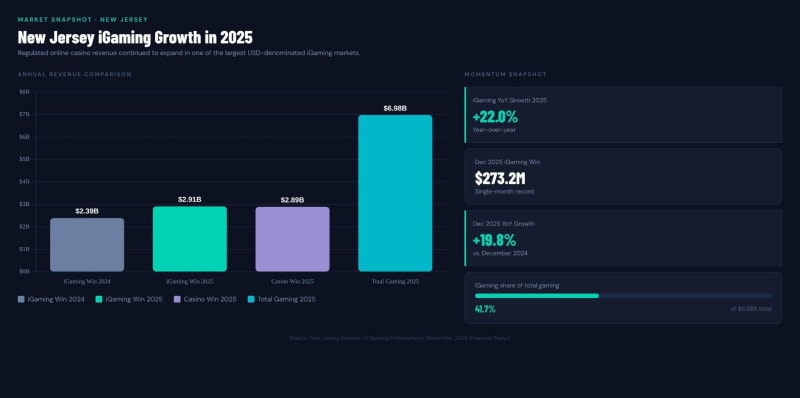
The comparison with land-based casino revenue matters. New Jersey reported $2.89 billion in Casino Win for the nine casino hotel properties in 2025. Internet Gaming Win, at $2.91 billion, slightly exceeded that figure. For payment analysis, that matters. It shows that online casino revenue in a regulated USD market is now comparable with the state’s traditional casino floor revenue.
Why Revenue Data Points Back to Payments
Revenue is not the same as deposit volume. Still, every online casino win figure begins with user balances moving through regulated systems. Players deposit, play, withdraw, redeposit, or leave funds in their account. Operators reconcile balances, manage chargebacks, report revenue, and calculate tax.
This is where USD becomes visible even when a public report does not list individual cashier transactions. A regulated U.S. online casino market is built around dollar-denominated reporting. That makes USD part of the market’s basic infrastructure, not just a cashier option.
For players, the practical effect is simple. In a USD-regulated market, the main user-facing numbers are usually presented in dollars: deposits, bonuses, wagering requirements, table limits, withdrawal thresholds, account balances, and tax forms.
New Jersey does not prove that USD is the default online casino currency worldwide. It proves something narrower and stronger: one of the most mature regulated iGaming markets is producing large, growing, official online casino revenue in USD.
USD Leads the Wider Payment System
Casino payments do not operate in isolation. Cards, bank transfers, and payment processors connect to wider financial rails. For international transactions, currency availability and settlement paths matter.
SWIFT’s Global Currency Tracker for March 2026 ranked USD first among global payment currencies by value for February 2026. USD accounted for 49.25% of global payments and 57.49% of international payments, excluding payments within the Eurozone.
The gap was wide. EUR accounted for 22.82% of global payments and 14.07% of international payments excluding intra-Eurozone flows. GBP followed at 7.16% and 5.68%. JPY stood at 3.46% and 5.11%, while CAD and CNY were both below 3% in the global payment ranking.

This does not mean a casino player is sending a SWIFT transfer every time they deposit. Most players are not. The relevance is broader. Payment processors, banks, acquiring partners, wallet providers, and cross-border services all operate within a system where USD remains the leading payment currency by value.
The Problem for Smaller Currency Markets
The hardest payment experience is often not in the largest markets. It is in countries where local currency support is limited, payment methods vary, or withdrawals are less direct than deposits.
We should be careful here. The available official data does not allow us to say that players in smaller countries always use USD. That would be too broad. What we can say is that when a local currency is not available, players are pushed into a second decision: which major currency will be used instead?
That decision can affect the real cost of play. A player may deposit in one currency, play in another, and withdraw through a method with its own conversion rules. Even a small exchange-rate margin can matter when deposits and withdrawals happen repeatedly.
For that reason, CasinoRank sees currency transparency as part of payment quality. A good cashier should make the account currency clear before deposit. It should explain whether conversion fees apply, whether withdrawals are paid in the same currency, and who sets the exchange rate.
Stablecoins Keep the Dollar in the Digital Payment Debate
Crypto payments are often framed as a move away from traditional money. The stablecoin market tells a more complicated story.
The Bank for International Settlements reported in May 2026 that approximately 98% of stablecoin value is dollar-denominated. That means much of the digital asset payment discussion still points back to USD. A blockchain-based payment can still be a dollar-linked payment if the asset is pegged to the U.S. dollar.
For online casinos, this distinction matters. A casino may describe a payment option as crypto, but a player using a dollar-pegged stablecoin is not taking the same currency exposure as someone using a volatile cryptoasset. The payment rail may be digital, but the reference value is still USD.
The BIS paper also notes that stablecoins could affect private-sector money use, especially in emerging market and developing economies. For casino payments, that means stablecoins should be treated as part of the wider currency discussion, not just as another icon in the cashier.
What Players Should Check Before Using USD
USD support is useful only when the full payment route is clear. Before depositing, players should check the account currency, accepted deposit methods, available withdrawal methods, conversion fees, and exchange-rate timing.
They should also check whether deposits and withdrawals can be completed through the same method. Some casinos support more deposit routes than payout routes, which can create friction after a win. Jurisdiction rules matter too, especially in regulated markets where identity checks, responsible gambling tools, and tax reporting may apply.
These points are not small details. They can decide whether a payment method is genuinely convenient or just available.
CasinoRank’s View
USD will remain important in online casino payments because it connects three separate trends. Regulated U.S. iGaming is producing large official revenue in dollars. The global payment system still ranks USD first by value. Dollar-denominated stablecoins show that even new digital payment models often keep USD at the center.
The better question is no longer whether USD matters. It does. The better question is how clearly casinos explain its role to players.
For CasinoRank, the future of casino payments is not just more methods. It is clearer payment information: accepted currencies, conversion rules, withdrawal limits, payout timing, and fees explained before the first deposit. As online casino markets grow and digital payment rails become more varied, operators that reduce payment uncertainty will offer the better user experience.
Sources
New Jersey Division of Gaming Enforcement — December 2025 Gaming Revenue Results.
SWIFT — Global Currency Tracker, March 2026.
Bank for International Settlements — The Impact of Stablecoins on the International Monetary and Financial System, BIS Papers No. 170.